Best Email Marketing Agency: 8 Options Compared for 2026
The best email marketing agency is the one that has already run your kind of program, reports on revenue instead of open rates, and works inside the platform you use. For an ecommerce brand that wants email and SMS to carry 30% or more of monthly revenue, a specialist like Chromex Marketing is the strongest fit. Full-service agencies suit brands that want email bundled into a wider contract. Freelancers suit tight budgets, and B2B teams need an agency built for lead generation.
Searching for an email marketing agency puts you in front of software roundups, paid directories and agencies that all describe themselves the same way. It is hard to tell what a monthly retainer actually buys. The usual result is a poor hire: thin automations, a sender reputation that slips, and reports full of numbers that never connect to sales.
This article compares eight options for outsourcing your email. For each one you get what it delivers, who it fits, where it falls short and how it is usually priced. After the list, you get a side-by-side table, a worked return-on-investment example and the questions that expose a weak agency on the first call. Chromex is first because this is our blog, and we say plainly where another option fits you better.
How we judged the best email marketing agencies
A good agency is judged on what it does to your revenue, your sender reputation and your workload, not on how polished its pitch is. We scored each option on seven criteria that predict a good outcome for an online store, so the ranking is not a popularity contest.

The seven criteria
Every option below was weighed against the same list. The first three matter most, because a miss on any of them is hard to fix later.
- Revenue focus. Does the agency set goals around revenue per recipient and the share of sales email drives, or only open and click rates?
- Automation depth. Does it build and maintain the flows that run without you, such as welcome, cart recovery and post-purchase sequences?
- Deliverability. Does it handle authentication, list hygiene and sender reputation, not just send volume?
- Creative. Are emails designed for your brand, or dropped into stock templates?
- Reporting. Can you read the report without a glossary, and does it tie to orders?
- Pricing clarity. Do you know what you pay and what changes the price?
- Fit with your platform. Does the team know Klaviyo, Omnisend or whatever you run?
An agency that cannot explain how it will lift revenue in plain language is not the best email marketing agency for you, whatever its reviews say.
Why ecommerce specialization changes the answer
The best ecommerce email marketing agency is usually a specialist, because online stores run on a repeatable set of automations tied to browsing, carts and repeat purchases. A team that builds those every week already knows which timing, offers and segments work. A generalist has to learn them on your budget.
Specialization also matters for platforms. Store data from Shopify and similar systems feeds segmentation and product recommendations, so an agency fluent in your email platform's ecommerce features moves faster. Deliverability is a second reason. Since Google and Yahoo tightened bulk sender rules in 2024, senders need SPF, DKIM and DMARC authentication, easy unsubscribing, and spam complaint rates kept low, with Google's stated ceiling at 0.3%. An agency that handles this daily protects your inbox placement.
The eight options at a glance
The table below puts all eight options side by side so you can narrow the field before reading the details. Pricing models are described in general terms because rates vary widely by scope and contract.
Side-by-side comparison
| # | Option | Best for | Usual pricing model | Main risk |
|---|---|---|---|---|
| 1 | Chromex Marketing | Ecommerce brands that want a done-for-you email and SMS program | Performance-based, not fixed packages | Ecommerce only, lean team |
| 2 | Boutique ecommerce specialists | Stores that want a small team and direct access | Monthly retainer | Quality varies, capacity limits |
| 3 | Full-service digital agencies | Brands that want email inside a wider contract | Retainer, often bundled | Email is one service among many |
| 4 | B2B and lead generation agencies | Companies selling to businesses | Retainer or per-campaign | Not built for retail lifecycle flows |
| 5 | Freelance email marketers | Small budgets and narrow tasks | Hourly, project or small retainer | One person, no backup |
| 6 | Consultants and audit advisors | Teams with someone to execute | Project fee or hourly | You still do the work |
| 7 | Platform partner agencies | Brands that want vetted help on one platform | Retainer | Badge does not equal quality |
| 8 | An in-house hire | Large programs needing daily control | Salary plus tools | One person rarely covers every skill |
Shortcuts by situation
If you run an online store and email is under 10% of revenue, start with options 1 and 2. If your marketing is spread across search, social and paid ads and you want one vendor, look at option 3. If you sell to other businesses, go straight to option 4. If you only need a flow rebuilt or an audit, options 5 and 6 cost the least.
Match the agency model to your business model first, then compare individual agencies inside that model.
1. Chromex Marketing
Chromex is a specialized email and SMS marketing agency for ecommerce brands, and it is our pick for stores that want the whole program handled for them. Founded in 2021 by Farhan Uz Zaman, it is a lean team of email marketers, designers and strategists.
What you get
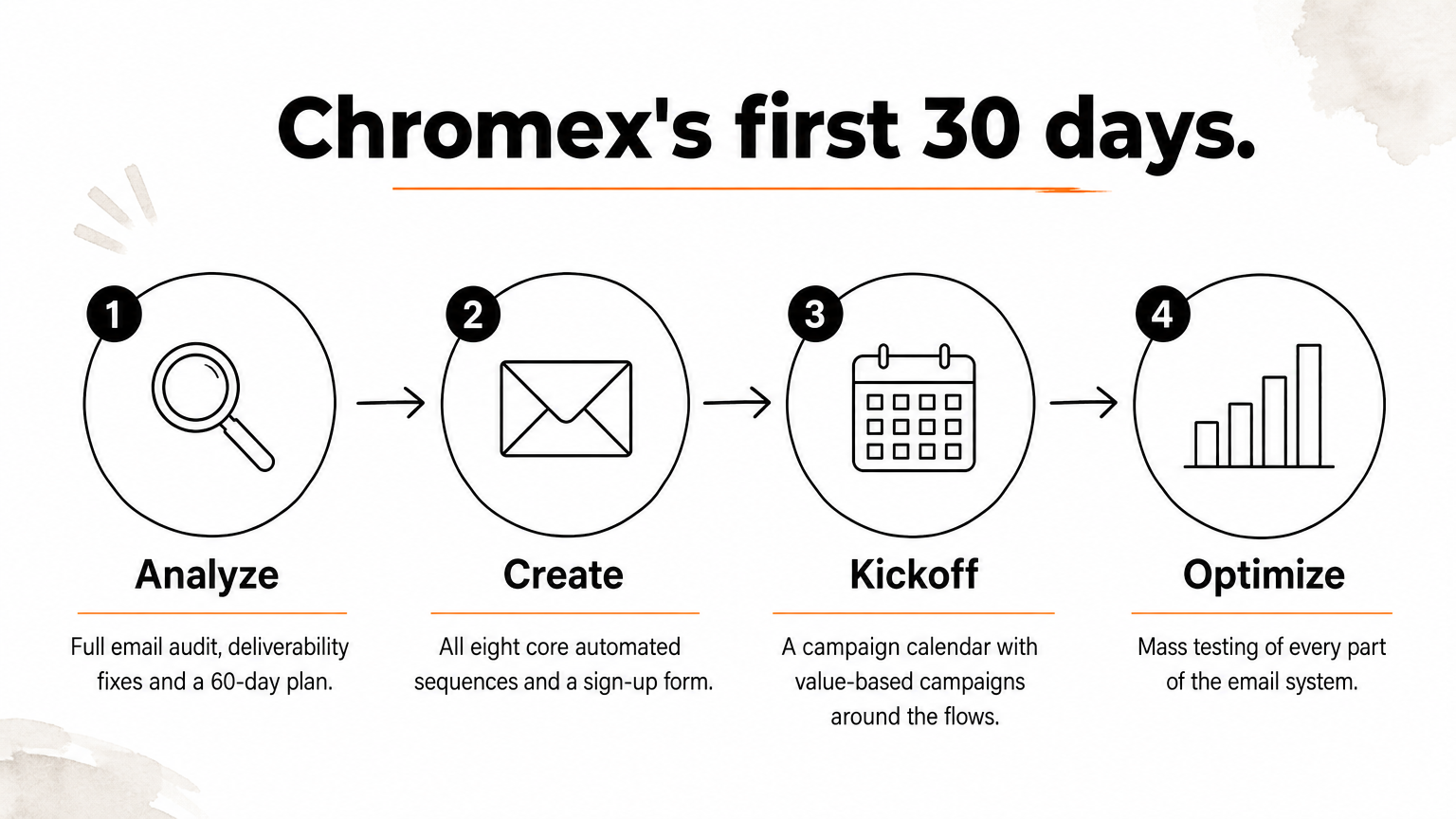
You get done-for-you retention and lifecycle marketing: strategy, automation setup, campaign execution, design, testing and reporting. The work follows a fixed four-step process, so you know what happens in your first 30 days.
| Stage | Timing | What happens |
|---|---|---|
| Analyze | Day 1 to 5 | Full email audit, deliverability fixes, market and competitor insights, 60-day action plan |
| Create | Day 5 to 15 | All 8 core automated email sequences and a high-converting sign-up form for list growth |
| Kickoff | Around day 15 | Campaign calendar and value-based campaigns that support the automations |
| Optimize | Day 30 onward | Mass testing of every part of the email system to compound revenue |
Every email visual is designed from scratch with no templates, and reporting is written in plain language. Chromex works on the major email platforms and is an official Omnisend partner.
Who it fits
Chromex fits founders and retention managers of Shopify-style ecommerce brands who already have traffic or ad spend but get a small share of revenue from email, often under 10%. It also suits brands burned by freelancers who vanished or agencies that sent generic templates. Chromex is trusted by more than 50 founders, and it states a 92% client retention rate.
On results, Chromex reports email driving an average of 45% of its clients' monthly revenue. One case study generated $500,000+ for a brand, with email driving nearly 70% of that brand's monthly revenue.
If email is a rounding error in your revenue and you have no one to run it, this is the situation a done-for-you ecommerce specialist is built for.
Trade-offs
Chromex only works with ecommerce brands, so a B2B software company or a services firm should look at option 4. It is also a lean team, which means you work with a focused group instead of a large agency with dozens of account managers. Done-for-you also means you approve work rather than build it, so expect to review designs and offers on a regular schedule.
How it is priced
Chromex describes its pricing as transparent, performance-based and scalable, not fixed packages, with the idea that you pay for what you get. Because the model is tied to results, ask on the intro call exactly what the fee is based on and what happens if a quarter underperforms. You can book that call through the scheduling link on the Chromex site.
2. Boutique ecommerce email and SMS specialists
Boutique specialists are small agencies that work only on ecommerce email and SMS, and they are the closest alternative to Chromex. Names that appear on ecommerce agency shortlists include Flowium, Chronos Agency, Hustler Marketing and Sweat Pants Agency. Treat any shortlist as a starting point and run the checks in the vetting section below.
What you get
Expect flow builds, campaign calendars, list growth and testing, delivered by a small team that knows the Shopify, Klaviyo and Omnisend ecosystem. The quality is highest when you work with the people who actually do the work, not a sales team that hands you off.
Ask for a sample audit or a written plan before signing. A specialist that cannot show how it would diagnose your account in a few pages probably runs a generic playbook.
Who it fits
This option suits stores that want specialist skills and direct access to the person building the flows. It also suits brands that want to compare two or three specialists before committing, because boutique agencies tend to be flexible about scope. If you want SMS handled alongside email, confirm the agency runs both channels and not just one.
Trade-offs
Quality varies a lot between small agencies. A strong boutique can outperform a famous agency, and a weak one can leave you with tangled flows. Capacity is the other risk: when a small team signs several clients at once, response times slip. Ask how many accounts each strategist handles.
A boutique is only as good as the people on your account, so insist on meeting them before you sign.
How it is priced
Most boutique agencies charge a monthly retainer, sometimes with a one-time setup fee for the first flow build. Some tie part of the fee to results. Always get the scope in writing, including how many campaigns per month, which flows are included and how reporting is delivered.
3. Full-service digital marketing agencies
Full-service agencies run email next to search, paid media, web design and social. Coalition Technologies describes itself as having over 16 years of experience and 40+ documented case studies, and positions its email work for ecommerce and lead generation brands. Thrive Agency lists email marketing within a wider digital marketing menu.
What you get
You get one contract and one team lead across several channels, which can make coordination easier. Email can then share data and messaging with your paid ads, landing pages and search content. Larger agencies also bring design, development and analytics under the same roof.
The catch is how deep the email bench goes. Ask who will actually build your automations, and whether that person works on email full time.
Who it fits
Full-service agencies fit brands that want to consolidate vendors, or companies without a marketing lead who can coordinate several specialists. If you are already paying the agency for ads or SEO, adding email can be convenient. They also suit larger brands that need many stakeholders and approval layers.
Trade-offs
Email is rarely the main revenue line for a full-service agency, so it can get less attention than ads. You may also pay for overhead, such as account managers and project coordinators, that a specialist does not carry. Contracts are often longer, so check the exit terms.
A full-service agency buys you convenience, and a specialist buys you depth, so decide which one your store actually needs.
How it is priced
Pricing usually comes as a monthly retainer, often bundled with other services into a single package. Ask for email to be itemized so you can see what it costs on its own. If the agency will not separate it, you cannot judge whether the email work is worth the fee.
4. B2B and lead generation email agencies
B2B email agencies build outbound and nurture programs that move prospects toward a sales call. This is a different job from ecommerce lifecycle marketing, so it is a different kind of agency.
What you get
You get list building, outbound sequences, nurture campaigns and reporting on meetings booked or pipeline created. The best ones also manage domains and mailboxes carefully, because cold outreach can damage a sender reputation quickly.
Compliance is part of the job. In the United States, CAN-SPAM requires a clear way to opt out, a valid physical postal address, and honoring opt-outs within 10 business days. A reputable agency treats those rules as the baseline, not an afterthought.
Who it fits
This option fits software companies, agencies, consultancies and manufacturers with a sales team and a clear buyer profile. If your goal is booked meetings instead of online orders, this is the right category and a retail email specialist is not.
Trade-offs
B2B agencies rarely build the cart, browse and post-purchase flows an online store needs. Results also depend heavily on your offer and your market, which no agency controls. Be wary of anyone who guarantees a number of meetings before seeing your pitch.
If your customers do not check out on a website, hire for pipeline, not for flows.
How it is priced
Expect a monthly retainer, and sometimes a per-meeting or per-campaign fee. Ask who owns the sending domains and lead data if you leave. Those assets should stay with you.
5. Freelance email marketers
A freelance email marketer is one person who builds your flows, writes your campaigns or manages your platform. It is the cheapest way to get experienced hands on your account, and the riskiest to depend on.
What you get
You usually get a focused scope, such as rebuilding a welcome series, writing a monthly set of campaigns or cleaning up a list. Good freelancers often have deep experience with one platform and communicate directly, without layers of account management.
Ask for work samples that show results, not just screenshots of designs. A freelancer who can walk you through why a flow earned revenue is worth far more than one who shows pretty emails.
Who it fits
Freelancers fit small stores, early-stage brands and teams with a specific, bounded need. They also suit companies that already have strategy in-house and need extra production capacity.
Trade-offs
One person means one point of failure. Illness, a full schedule or a new job can stall your program, and nobody covers for them. Few freelancers cover strategy, copy, design, development and analytics equally well, so you may end up with gaps. Handover is also messy if they leave without documentation.
Hire a freelancer for a defined job, and require written documentation of every flow they build.
How it is priced
Rates come as hourly, per-project or small monthly retainers, depending on the person. Agree on deliverables and a revision limit in writing. Make sure you own the platform account, so the work stays with you.
6. Email consultants and audit-only advisors
A consultant reviews your program and tells you what to fix, while your team does the execution. It is the most practical option when you have someone in-house but lack the expertise to direct them.
What you get
You get an audit, a prioritized roadmap and often training or periodic strategy sessions. A solid audit covers authentication and deliverability, list health, flow coverage, segmentation, sign-up forms, creative and reporting. The output should be a ranked list of fixes with expected impact, not a long report with no order.
Who it fits
Consultants fit brands with a marketing manager or a small team that can implement recommendations. They also suit founders who want a second opinion before signing a retainer with an agency, so they know what good looks like.
Trade-offs
The advice only pays off if someone acts on it. Many audits end up unread because the team is busy. A consultant also sees your numbers at a point in time, so ask whether any follow-up review is included. If nobody on your side can build flows, an audit alone leaves you where you started.
An audit is only worth buying if someone on your team has time to implement it.
How it is priced
Consultants usually charge a project fee for an audit or an hourly rate for advisory work. Compare the scope, not just the price, since one audit may be a 30-minute skim and another a full account review. Done-for-you agencies often include an audit as their first step, as Chromex does in its Analyze stage.
7. Platform partner agencies from vendor directories
Email and ecommerce platforms such as Shopify, Klaviyo and Omnisend maintain partner directories of agencies that work on their software. This is a sourcing route more than a type of agency, and it is useful because it narrows a huge field quickly.
What you get
You get a list of agencies that know a specific platform and have some relationship with the vendor. That means they should understand its newer features, such as predictive segments or built-in SMS, and have a contact at the vendor for hard problems.
Use the directory to build a shortlist of three to five, then vet each one with the same questions. Platform expertise is a plus. It does not replace evidence of results.
Who it fits
This works best when you already chose your platform and want help on it, or when you are switching and want a team that has done migrations. It also helps when you are unsure where to start and want a vetted pool.
Trade-offs
A partner badge shows a relationship, and often a minimum level of activity, but it does not guarantee quality for your store. Some agencies stay on the list because they refer software, not because of results. Ask what the badge requires and for references from stores your size.
Use a partner directory to find candidates, not to choose between them.
How it is priced
Pricing varies by agency and is usually a monthly retainer. Some partners can also pass along vendor promotions or onboarding credits, so ask about them. Never let a discount on software drive the choice of who runs your program.
8. An in-house email marketer
Hiring one email marketer is the alternative to every agency above. It gives you daily control and a person who knows your products, and it is a real option once email is large enough to justify a salary.
What you get
You get someone who builds, tests and sends on your schedule and sits in your team meetings. They learn your customers and catalog deeply, and can react the same day to a launch or a stock issue.
The challenge is range. Strong email work needs strategy, copywriting, design, development and analysis. One hire seldom excels at all five, so many brands pair an in-house person with a design contractor or an agency.
Who it fits
In-house fits brands with a large list, frequent launches and enough revenue to cover a full salary plus the software stack. It also suits companies that want to own every asset and process and have the management time to coach a hire.
Trade-offs
Hiring takes time, and a mistake costs months. A single employee has no backup when they are out and can stall without peers to learn from. You also carry salary, benefits and tools whether or not the program is working that month.
In-house is a good second step. Many brands start with an agency, learn what works, and hire later.
How it is priced
You pay salary plus benefits, the email platform, and any contractors for design or development. Compare that total against an agency retainer, not just the salary, and include the months a new hire needs to ramp up.
How to vet an email marketing agency before you sign
Vet an agency by testing its numbers, its people and its contract terms before any money moves. A short checklist and a quick revenue calculation will filter out most weak options.
Run the math before you hire
Start with what a better email program is worth. Say your store earns $100,000 a month and email drives 8% of that, or $8,000. If a stronger program lifts email to 30% of the same revenue, email would bring in $30,000, a $22,000 difference.

Be careful with that figure, because some email-attributed revenue would have happened anyway through other channels. Now convert it to margin. At a 40% contribution margin, $22,000 of extra revenue is $8,800 a month. Any agency fee should sit well below that number, or the program will not pay back quickly.
Questions to ask on the first call
Use the same questions with every agency so the answers are comparable.
- Who will work on my account, and how many other accounts do they handle?
- Which flows will you build first, and why?
- How do you handle authentication, list cleaning and deliverability problems?
- Do you design from scratch or adapt templates?
- What does the report look like, and can you show me a real one with the client name removed?
- How is your fee calculated, and what changes it?
- Who owns the platform account, flows and designs if we part ways?
- Can I speak to a client with a store similar to mine?
Red flags that should end the call
Walk away from guaranteed revenue numbers, reports that only show open rates, and any refusal to show the people who will do the work. Be careful with contracts that lock you in for a year with no exit clause. A vague answer about deliverability is also a warning, since a damaged sender reputation takes months to repair.
The best email marketing agency welcomes hard questions, and the weak ones answer them with a sales deck.
Common questions about hiring an email marketing agency
These short answers cover what readers most often ask before they commit to an agency.
Is email marketing still worth it in 2026?
Yes, email is still one of the best-returning channels for online stores. You own the list, so you are not paying for each visit the way you do with ads, and rising ad costs make repeat purchases from existing customers more valuable.
The catch is quality. Inbox rules are stricter than a few years ago, and generic blasts perform poorly. Programs built on automations and segmentation hold up best.
What is the 80/20 rule in email marketing?
The rule is usually read in one of two ways. The first is a content balance: about 80% of your emails should help, entertain or inform, and no more than 20% should be a direct sales pitch. That keeps subscribers engaged and complaints low.
The second reading says that roughly 20% of your subscribers produce most of your revenue. It is a useful reminder to segment your best customers and treat them differently.
Is the best email marketing service software or an agency?
Software and agencies solve different problems. Platforms such as Klaviyo and Omnisend are the tools that send your emails, and an agency is the team that plans, builds and runs the program on top of them.
If you have the time and skill, you can run the software yourself. If you do not, an agency turns the software into revenue. A good agency works on the platform you already pay for.
Picking your email partner
The best email marketing agency is not one name for everyone. It is the model that matches your business: a specialist for ecommerce brands, a full-service agency for bundled marketing, a B2B shop for pipeline, and a freelancer, consultant or in-house hire when the job is smaller or more hands-on. Vet any option with the same questions, check the math against your margin, and insist on meeting the people who will do the work.
If you run an online store and want email and SMS handled end to end, book an intro call with Chromex and we will walk you through what an audit and the first 30 days would look like for your brand.