5 Ways to Hire an Ecommerce Email Marketing Consultant
The right ecommerce email marketing consultant owns a revenue number, not just open rates, and can build and fix flows on Klaviyo or Omnisend. If you want everything handled for you, a done-for-you agency like Chromex fits best. If you need a second opinion on your account, hire a one-off audit consultant. If you have a small budget and time to manage someone, an independent freelancer or a marketplace hire works. If email already drives a big share of sales, build an in-house role.
Most stores know email should earn more than it does. Picture a store doing $100,000 a month with email at 8% of revenue, or $8,000. Moving email to 30% through flows and campaigns means $30,000, an extra $22,000 every month. That gap is what you are hiring for, and a wrong hire costs you months of it.
This article walks through five ways to hire help, in order from most hands-off to most hands-on. Each one covers how it works, who it suits and what it costs. Email work is done remotely, so you do not need a consultant near you. You need one who fits your store's size, platform and workload.
1. Chromex Marketing: done-for-you agency
How it works
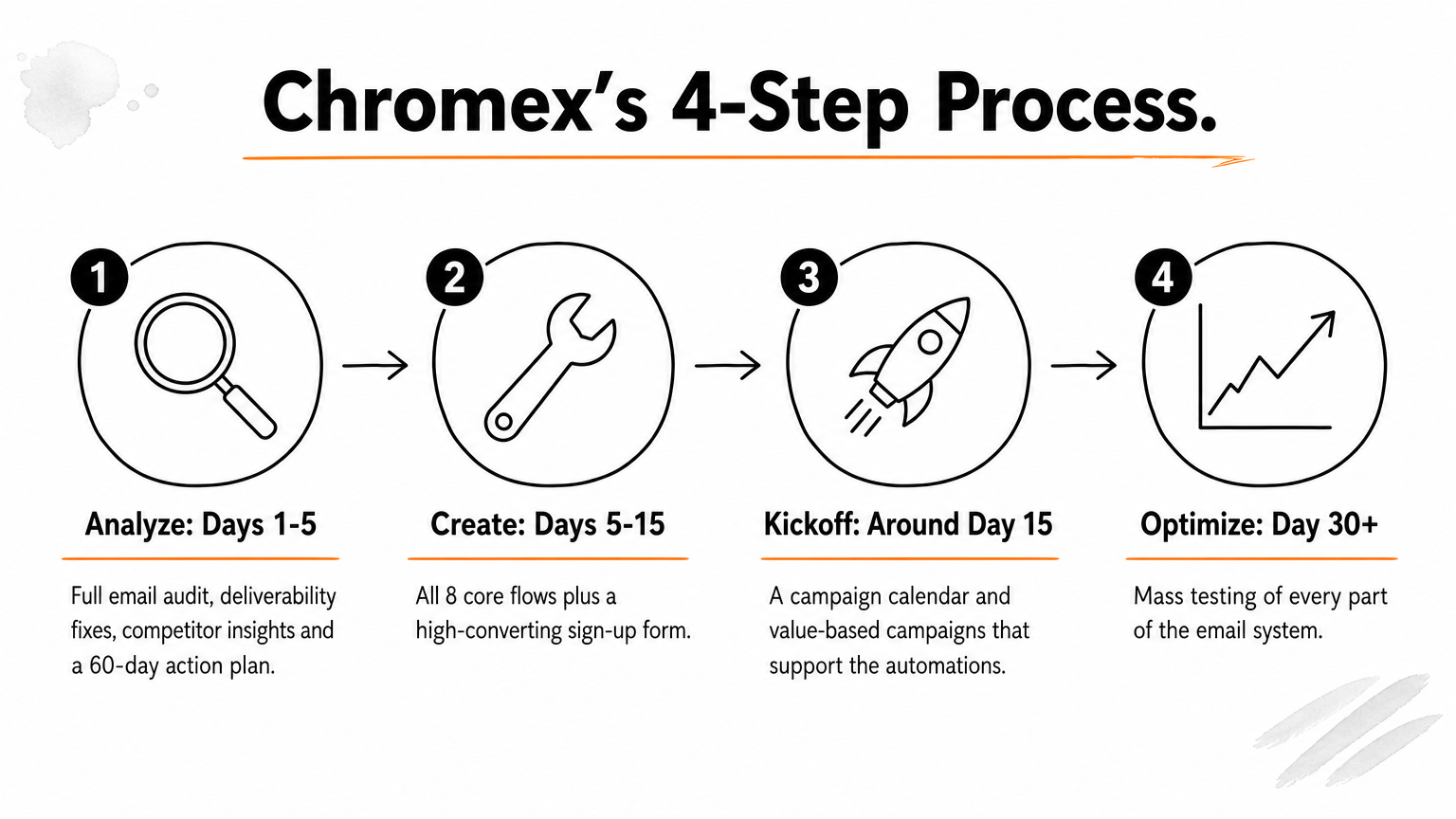
Chromex is a specialized email and SMS agency for ecommerce brands, founded in 2021 by Farhan Uz Zaman. It runs a four-step process with dated milestones:
- Analyze (days 1 to 5): a full email audit, deliverability fixes, competitor insights and a 60-day action plan.
- Create (days 5 to 15): all 8 core automated flows plus a high-converting sign-up form for list growth.
- Kickoff (around day 15): a campaign calendar and value-based campaigns that support the automations.
- Optimize (day 30 onward): mass testing of every part of the email system.
Every email is custom designed, with no templates. The team works on major platforms and is an official Omnisend partner.
A good agency gives you a dated plan, so you always know what ships next.
Who it suits and what it costs
Chromex fits brands that already have traffic and a list, but where email brings in under 10% of revenue. It also suits founders who got burned by inconsistent freelancers. The agency reports 92% client retention and $14M+ in email-attributed revenue. One client case produced $500,000+, with email driving nearly 70% of that brand's monthly revenue.
On cost, Chromex uses transparent, performance-based pricing instead of fixed packages. You can book a call through the online scheduling link to talk through your needs.
2. Independent freelance consultant
How it works
An independent consultant is one senior person who audits your account, maps your flows, writes copy and reviews results with you each month. You get direct access to the person doing the thinking. Design and development are often subcontracted or left to you.
Before you sign, confirm four things:
- Who builds the flows in your platform.
- Who designs the emails.
- Who covers the work when the consultant is out.
- How often you get a report, and in what format.
With a solo consultant, ask what happens when they are unavailable.
Who it suits and what it costs
This route suits small to mid-sized stores that want senior judgment without agency overhead. It works less well if you need high campaign volume, custom design and SMS all at once, because one person has limited hours.
Rates vary widely with experience, so compare scope, not hourly rate. Ask for hours per month, named deliverables and how success is measured. A cheaper consultant who delivers two flows a quarter costs more than a pricier one who ships weekly.
3. Marketplace freelancers
How it works

On a marketplace such as Upwork, you post a brief and receive proposals within days. This is the fastest way to start, and the pool is large. Quality swings widely, so the vetting is on you. Start with a paid test project, such as building one abandoned cart or welcome flow, before you hand over the whole account.
Use these screening questions:
- Which store like mine did you grow, and by how much?
- Can you show flow screenshots and their revenue results?
- How do you decide what to test first?
- Which platforms are you certified or experienced in?
Never hand over a whole account before a paid test project.
Who it suits and what it costs
Marketplace hiring suits one-off builds, short experiments and stores with a tight budget and a manager who can review the work. It is a poor fit if you want a long-term retention partner, since freelancers on these sites come and go.
You set the budget, either hourly or as a fixed price. The platform takes a service fee, so check its current terms. Expect to spend your own time on briefs and review.
4. One-off audit and strategy consultant
How it works
An audit consultant reviews your whole email program for a defined project, then leaves you with a plan. The review usually covers flows, segmentation, sign-up forms, deliverability setup such as SPF, DKIM and DMARC, and reporting. You receive a prioritized roadmap, often with a walkthrough call. Your team does the execution.
This is a smart way to find out what is broken before you commit to a monthly retainer.
An audit tells you what to fix first, but only your team can ship it.
Who it suits and what it costs
It suits stores that have a marketer or designer who can build but lacks direction. It also works as a second opinion on an agency's work when results stall.
Audits are usually sold as a fixed project fee. Ask what the fee includes: account access, number of flows reviewed, a follow-up call, and whether a 30 or 60-day plan comes with it. The spend is lower than a retainer, but no one is accountable for revenue because no one is building.
5. Full-time in-house email manager
How it works

An in-house manager owns your calendar, flows, segmentation, testing and reports every day. You get deep knowledge of your products and customers, and instant availability. That person still needs support: design, copy and sometimes development, plus your platform subscription.
Hiring takes weeks, and the first months are a learning curve. Many stores pair a new hire with an audit consultant so the manager starts with a clear plan instead of guesswork.
Hire in-house only when email has enough work to fill a full week.
Who it suits and what it costs
This option suits brands where email and SMS already produce a large share of revenue and the workload justifies a full-time seat. It is a weak first step for a store at 5% email revenue, because you pay full salary before you know the channel's ceiling.
Budget for salary and benefits, platform fees and design support. Salary depends on your market and the person's seniority, so check current listings for comparable roles before you set a number.
Pick the model that matches your gap
Choose by what is missing. If you lack time and expertise, an agency covers both. If you lack only direction, an audit consultant is enough. If you lack hands, a freelancer or a marketplace hire adds capacity. If you have a proven channel and steady work, hire in-house.
Whichever route you take, insist on a revenue target, a dated plan and plain-language reporting. Those three things separate real operators from people who sell open rates.
If you want the audit, the flows and the campaigns built for you, book a call with Chromex and see what email could add to your store.