Email Marketing Agency Pricing: What You'll Actually Pay
Email marketing agency pricing is what an agency charges to plan, build, send and improve your email program for you. Most full-service agencies bill a monthly retainer of about $2,500 to $10,000. Freelancers and consultants usually bill $75 to $150 an hour, and a standard campaign email costs $250 to $1,000 when priced one at a time. Simple programs can fit a $1,000 to $3,000 retainer, and complex enterprise work goes past $10,000.
The range is wide because you are not buying emails. You are buying a team's time and judgment. A strategist, a designer, a developer and someone who knows your sending platform all touch a single campaign, and agencies price by how many of those people your program needs and how often they work. Chromex runs email and SMS programs for ecommerce brands, so this is a topic we know from the inside.
This guide covers why the price deserves scrutiny, how the pricing models work, what consultants and freelancers charge, what moves a quote up or down, and how to build a budget and compare proposals. The figures are ranges reported across the US market, not quotes, so use them to judge whether a proposal is realistic.
Why email marketing agency pricing needs a close look
Email marketing agency pricing needs a close look because offers that sound identical can differ by thousands of dollars a month. The difference is almost always the amount of skilled human time behind your account. A $500 retainer and a $10,000 retainer can both be labeled "email management" while covering very different work.
What the fee actually pays for
Your fee pays for a team, not a send button. A solid program touches six jobs:

- A strategist or account manager who sets goals and reads the results
- A copywriter who writes the subject lines and body copy
- A designer who builds the email visuals
- A developer who codes emails so they render in every inbox
- A platform specialist who builds flows, segments and signup forms
- A quality assurance check before every send
Agencies spread these salaries across several clients, which is why retainers sit in the thousands and not the tens of thousands. One freelancer can cover two or three of these roles well. Nobody covers all six well at the same time, and a price that assumes otherwise is a warning sign.
You are paying for the number of skilled people who touch your account, not for the number of emails that go out.
Why the lowest quote often costs more
Quotes of $300 to $900 a month for full-service work should make you cautious. At that price the provider either spreads one person across dozens of accounts or leaves out strategy, testing and custom design. You get emails sent, not a revenue channel.
The cost of a weak program also stays hidden. Poor deliverability, generic flows and untested subject lines cost you sales that never show up on an invoice. A low fee can make sense for a simple monthly newsletter. It rarely makes sense for an ecommerce store that wants email to carry 30% or more of its revenue.
How much of your budget email should take
Most guidance puts email at 6% to 10% of your total marketing budget, agency fees included. That share can reach 20% when email drives core revenue, as it does for many ecommerce and subscription brands. A store that spends $600,000 a year on marketing lands at $36,000 to $60,000 a year, or $3,000 to $5,000 a month.
That monthly figure sits inside the typical retainer range, which makes it a useful sanity check before you request a single quote. If your number lands far below $2,500 a month, plan for a freelancer or a lean scope instead of a full-service team.
How to read the main email marketing agency pricing models
Agencies charge in six ways: monthly retainer, hourly rate, per email, per project, performance-based fees, or a hybrid of these. Retainers are the most common for ongoing work. Knowing which model a proposal uses tells you who carries the risk if the work takes longer or performs worse than expected.
The models side by side
The table sets the typical ranges reported across agency price guides next to the situation each model fits best.
| Model | Typical range | Best for |
|---|---|---|
| Monthly retainer | $1,000 to $3,000 (small programs), $3,000 to $10,000+ (larger programs) | Ongoing flows and campaigns |
| Hourly | $100 to $200 for agencies, $15 to $250 for freelancers | Audits, advice, one-off fixes |
| Per email | $250 to $1,000 typical, $200 to $1,500 reported, complex emails up to $10,000 | Occasional campaigns |
| Per project | $1,000 to $5,000 for a 3-email automation, more for full builds | One-time flow setup |
| Performance-based | A share of email revenue, no standard rate | Brands that want fees tied to results |
| Hybrid | For example $3,000 a month plus 5% of email revenue above $50,000 | Predictable base with upside |
Treat the top of each range as the price of complexity, not of luxury. Dynamic content, many segments and custom design are what push a single email toward $1,500 and beyond.
Retainers
A retainer is a flat monthly fee for a defined scope of work. Agencies favor it because learning your brand and tuning your program takes months, and a steady fee lets the team plan that work. You benefit from continuous access to the same people.
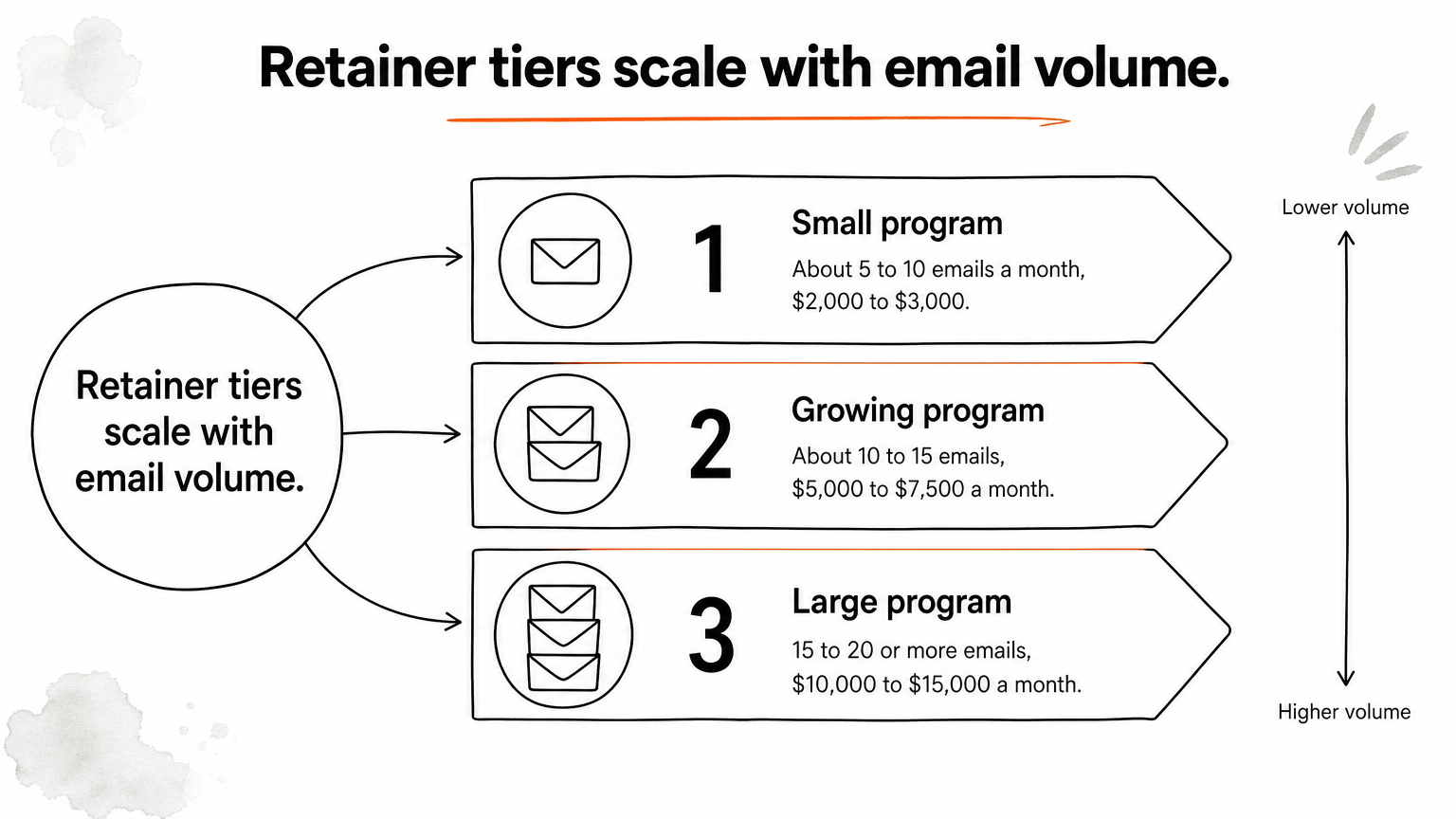
Retainer tiers usually scale with email volume:
- $2,000 to $3,000 a month: about 5 to 10 emails
- $5,000 to $7,500 a month: about 10 to 15 emails
- $10,000 to $15,000 a month: 15 to 20 or more emails, often with advanced segmentation, deeper analytics and strategic planning
Some agencies add a one-time setup fee on top, so ask for it up front.
Hourly and per-email fees
Hourly billing is rare among established agencies. Experienced email agencies that do bill hourly typically charge $150 to $200 an hour, and US marketing agencies average roughly $100 to $150, with design and development closer to $175. The risk sits with you, because a task that takes longer than estimated produces a bigger invoice.
Per-email pricing works for occasional sends, but it gets expensive at volume, because every email carries its own strategy, design and copy work. That is why agencies prefer to spread the cost across a monthly retainer.
Projects and hybrid deals
A project fee gives you one quote for a defined deliverable, such as a welcome flow, an abandoned cart sequence or a post-purchase series. A 3-email automation runs $1,000 to $5,000. Larger multi-flow builds with custom design cost more, and larger agencies quote them well above that.
Hybrids combine a base fee with a performance component. Take the $3,000 plus 5% example above. If email drives $80,000 in a month, the bill is $3,000 plus 5% of $30,000, which is $1,500, for $4,500 in total. You get predictable costs and the agency has a reason to grow revenue.
Performance-based pricing
Pure revenue-share deals are less common than they sound. Attributing sales to email is messy, because some buyers would have purchased anyway, and both sides can argue over how much revenue counts. Chromex prices on a transparent, performance-based model instead of fixed packages, so the fee follows results.
If you consider this model with any agency, get the attribution rules in writing: which sales count, over what window, and which platform's numbers are the source of truth.
Every pricing model moves risk from one side to the other, so choose the one where the party who controls the outcome carries the risk.
What email marketing consultants and freelancers charge
Email marketing consultants and freelancers typically charge $15 to $250 an hour, with most experienced practitioners between $75 and $150. Part-time monthly arrangements run $500 to $2,000. The spread tracks experience, and the same word, "consultant," can describe a beginner or a former agency strategist.
Rates by experience level
The table separates the rate tiers so you can see where a quote falls.
| Provider | Typical rate | Usually covers |
|---|---|---|
| Entry-level freelancer | $15 to $35 per hour | Basic sends using templates |
| Experienced freelancer or consultant | $75 to $150 per hour | Strategy, flow builds, deliverability fixes |
| Senior specialist | Up to $250 per hour | Audits and complex builds |
| Part-time freelancer retainer | $500 to $2,000 per month | List management, copy, campaign execution |
| Established agency, hourly | $150 to $200 per hour | A full team's work |
Marketplace listings tend to cluster at the low end, roughly $15 to $40 an hour. Those rates often reflect location and experience, not the value delivered to your business.
A typical one-off engagement shows how this adds up. An audit plus a flow build usually takes 20 to 40 hours. At $75 to $150 an hour, that is $1,500 to $6,000 for the whole job.
When a consultant beats an agency
A consultant makes sense when you already have someone in-house who can execute but needs direction. Typical jobs are an audit, a flow map, a deliverability review or training for your team. You pay for expertise by the hour or for a defined deliverable, and you keep the execution cost inside your own payroll.
An agency makes sense when you need volume and range: custom design, a steady campaign calendar, testing across every flow, and reporting. A freelancer who covers all of that alone becomes a single point of failure. If they get busy, your sends stop. Ask any consultant exactly what they deliver for the fee, and whether execution is included or billed separately.
Hire a consultant for direction when you can execute yourself, and hire an agency when you need the execution itself.
What pushes email marketing agency cost up or down
Email marketing agency cost rises with scope, complexity, list size, send frequency and design customization, and falls when you keep programs simple and templated. Your platform and industry matter too. These factors explain why two stores with the same revenue can receive quotes thousands of dollars apart.
Scope and complexity
Scope is the biggest lever. A monthly newsletter costs far less than a program with welcome, abandoned cart, post-purchase and winback flows plus weekly campaigns. Segmentation, personalization and A/B testing each add planning, build and analysis hours. So do dynamic content blocks, behavioral triggers and integrations with other channels such as SMS.

Design is its own line. Templates keep costs down. Custom visuals built around your brand cost more, but they are what makes emails stand out in a crowded inbox. Industry shapes scope as well: ecommerce usually needs many automations running at once, while B2B tends to need fewer emails with heavier personalization.
List size, frequency and platform
A bigger list rarely changes the agency's fee directly. It does bring more segmentation, more deliverability work and more audience management, and all of that eventually shows up in your quote. Frequency works the same way. Four campaigns a month and daily sends are different workloads, and agencies price them differently.
Platform matters because some tools take longer to build in than others. Many agencies specialize in one or two email service providers and quote preferred rates for them. If an agency pushes one platform hard, ask whether it earns a commission or resells the software.
Costs that sit outside the agency fee
Most agencies do not include email software in the retainer. Expect these to be billed separately:
- Platform subscription: entry plans for small lists start at roughly $9 to $40 a month, with steps up at contact thresholds such as 2,000, 5,000 and 10,000.
- Sending volume: on per-send pricing, 1,000 emails cost about $1.20 at a $1.20 CPM (cost per thousand) and $10 at a $10 CPM. Most subscription plans bundle sends.
- List cleaning: verification tools cost about $50 to $200 per run on a list of 10,000 to 50,000 contacts, and clean lists keep you in lower pricing tiers.
The agency fee is only part of the bill, so add the platform and list costs before you compare any two quotes.
How to budget for outsourcing email marketing
To budget for outsourcing email marketing, set a ceiling from your marketing spend, list the work you need, price each piece against the ranges above and compare the total to a retainer. That gives you a number to hold quotes against, so you are not guessing when proposals arrive.
A four-step estimate with a worked example
- Set the ceiling. Take 6% to 10% of your annual marketing budget.
- List the work. Count flows to build, campaigns per month, SMS, and any signup form work.
- Price each piece. Use the project, per-email and hourly ranges.
- Compare with a retainer. Divide the monthly total by the emails delivered.
Take a store that needs three core flows built and 12 campaigns a month. Three flows at $1,000 to $5,000 each is a one-time $3,000 to $15,000. Twelve campaigns at $500 each is $6,000 a month, or $72,000 a year.
A retainer near the bottom of the $5,000 to $7,500 tier that covers those same 12 emails works out to about $417 per email. That is $60,000 a year, $12,000 less than paying per email. Add the platform fee on top, and check the total against your ceiling from step one.
Questions to ask before you sign
A good proposal answers these without being pushed:
- Who works on my account, and how many other accounts do they handle?
- Which tasks are in the fee and which are billed extra?
- How is revenue attributed, and whose numbers are the source of truth?
- Does the scope include deliverability fixes and testing?
- How are results reported, and in what language?
- What are the contract length and exit terms?
Ask also what the first 30 days look like. A well-scoped engagement has a visible timeline. At Chromex, for example, days 1 to 5 cover the email audit, deliverability fixes and a 60-day action plan, days 5 to 15 build the 8 core automated sequences plus a signup form, and the campaign calendar starts around day 15. Testing begins at day 30. A timeline like that lets you hold the agency to something concrete.
Red flags in a quote
Some patterns should slow you down:
- A flat price with no written scope
- Guaranteed revenue numbers before anyone has seen your data
- No named team members
- Long lock-ins with no exit clause
- Open-ended hourly billing with no cap
- Pressure to use one platform without a clear reason
A vague quote leaves room for surprise invoices later. A quote that spells out deliverables, timing and reporting is worth a higher price than one that does not.
A fair quote names what you get, when you get it, and how you will know it worked.
What to do with these numbers
Email marketing agency pricing comes down to how much skilled time your program needs. Retainers of roughly $2,500 to $10,000 a month cover most full-service work, consultants and freelancers cost less per hour but carry less capacity, and the price rises with scope, complexity and design. Set your ceiling at 6% to 10% of marketing spend, price the work you actually need, and compare every proposal against that figure.
If you run an ecommerce brand and want to see what a scoped, performance-based engagement would look like for your store, you can book a discovery call with Chromex and walk through your list, flows and revenue goals.