Email Marketing Ecommerce Case Study: 5 Lessons to Copy
The strongest email marketing ecommerce case study examples share three traits: a clear starting point, a result tied to revenue instead of opens, and tactics you can repeat in your own store. This list covers five. The first two suit founders whose email share of revenue is still small. The third and fourth suit stores with an existing list and a campaign calendar that needs work. The fifth suits anyone who has to prove ROI before spending more.
Most case studies you find online are vague. They quote a big percentage, skip the baseline, and leave you guessing what to do next. Each item below gives the result, what usually drives a result like it, and what to copy. Where a figure comes from a published case study, we describe the result and not details the write-up does not give.
We are Chromex Marketing, an email and SMS agency for ecommerce brands, so the first two items come from our own client work. Treat every number in this article, ours included, the way you would treat any outside claim: ask about the baseline first.
1. $500,000+ with email at nearly 70% of revenue
The result
One Chromex client brand has generated $500,000+ through email, and email now drives nearly 70% of its monthly revenue. That share is unusually high. Most stores we speak with start below 10%, so this account shows what the channel can become when it is run as a revenue system.
What drives it
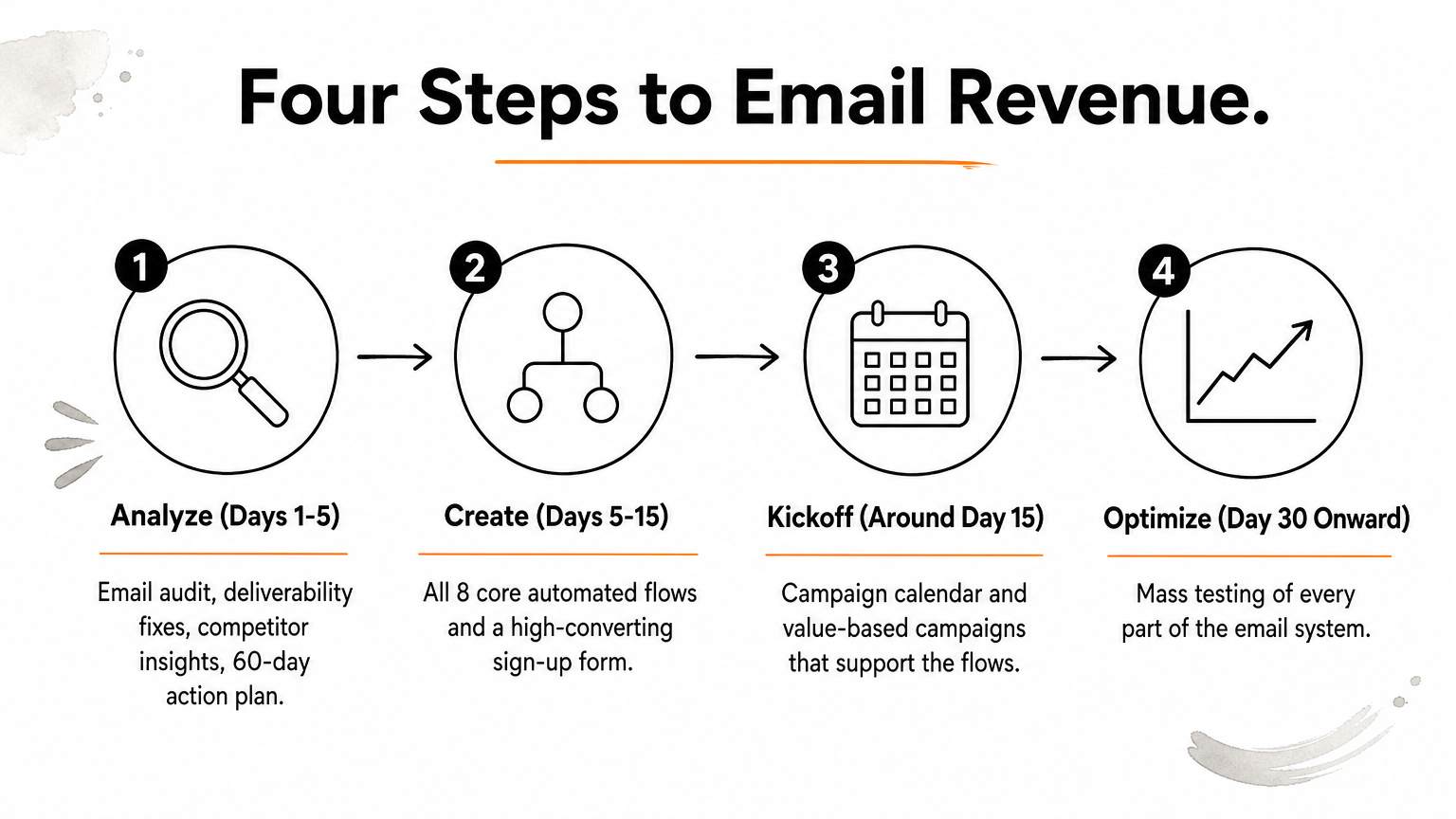
Chromex works every account through the same four steps, and the order matters.
| Step | Days | Work |
|---|---|---|
| Analyze | 1 to 5 | Email audit, deliverability fixes, competitor insights, 60-day action plan |
| Create | 5 to 15 | All 8 core automated flows and a high-converting sign-up form |
| Kickoff | Around 15 | Campaign calendar and value-based campaigns |
| Optimize | 30 onward | Mass testing of every part of the email system |
Flows come before campaigns because they earn revenue around the clock, while a campaign earns once. Campaigns then support the flows instead of carrying the whole program.
Email becomes a primary revenue channel when automations do the steady work and campaigns add the spikes.
What to copy
- Audit your current flows and deliverability before building anything new.
- Cover the core lifecycle moments with automations: welcome, abandoned cart, post-purchase and win-back are the usual starting points.
- Add campaigns only once the flows run, and plan them on a calendar.
- Start testing after the first month, when you have enough data to compare.
2. Email growing from under 5% to 36% of revenue
The result
Chromex clients report email growing from under 5% to 36% of monthly revenue. Other client testimonials cite revenue lifts of 31%, 37% and 367%. These are client-reported figures with different starting points, so compare the direction and not the exact numbers.
What drives it
The common starting point is deliverability. If your emails land in spam, no flow can earn, however good the copy is. Google's email sender guidelines require bulk senders to authenticate their domain and keep spam complaints under 0.30%. Fixing that is the first job in an audit.
After deliverability, weak or missing flows are the usual gap. A store with only a basic welcome email and a one-message cart reminder leaves most of its list unmonetized.
A low email share of revenue is usually a deliverability or automation problem, not a creative one.
What to copy
Work in this order:
- Authenticate your sending domain (SPF, DKIM, DMARC).
- Remove subscribers who have not opened or clicked in a long time.
- Fill the flow gaps, then add a sign-up form that grows the list.
Track email's share of total revenue monthly. As an illustration, a store at $100,000 a month with 5% from email earns $5,000 through the channel. At 36% of the same total, that is $36,000. Attribution is never perfect, but the share tells you how much room you have.
3. A clothing brand's $541K in six months
The result

A publicly shared case study reports a clothing brand reaching $541K in email-attributed revenue over six months. That averages about $90,000 a month. The brand started from a modest email share, which is why the story resonates with stores that treat email as an afterthought.
What drives it
Apparel is one of the best fits for email. Customers buy repeatedly, new drops arrive on a schedule, and size, style and color data make segmentation easy. Brands in this category usually lean on three things: campaigns tied to new collections, back-in-stock alerts, and offers matched to what each customer bought before.
Six months is also a sensible window. It is long enough to cover a seasonal cycle and show whether results hold after the launch bump.
Segmenting by purchase history lets one list behave like several smaller, better-matched ones.
What to copy
Split your list into three segments before your next send:
- Buyers from the last 30 days, who need cross-sell, not discounts.
- Your top spenders, who deserve early access to new products.
- Lapsed customers past 90 days, who need a win-back offer.
4. $139K from newsletter campaigns
The result
A published case study reports $139K from newsletters. Newsletters here mean the campaigns you send manually to your list, as opposed to automated flows. They are the part of email most stores already do, and often do poorly.
What drives it
Revenue per send depends on value-based campaigns. These mix useful content, product education and offers, so subscribers keep opening instead of learning to wait for discounts. Frequency matters too, but only when the audience is engaged.
Here is an illustrative model for a store with 20,000 subscribers sending 8 campaigns a month, which is 160,000 sends:
| Revenue per recipient, per send | Monthly campaign revenue |
|---|---|
| $0.05 | $8,000 |
| $0.10 | $16,000 |
| $0.15 | $24,000 |
Small gains in revenue per send compound quickly across a full month of campaigns.
What to copy
Build a monthly calendar before you write a single email. Assign each campaign a job: launch, education, social proof or offer. Send to engaged subscribers first and review revenue per recipient after every send, not just open rate.
5. 873% ROI and a 1200% jump in order value
The result
Published case studies report figures like an 873% ROI and a 1200% increase in order value. Read them carefully. An 873% ROI means every $1 spent returned about $9.73 in revenue, or $8.73 in profit. If you spend $2,000 a month on email, that is roughly $19,460 in revenue and $17,460 in profit.
What drives it
Email is cheap to send, so ROI climbs once the flows exist and keep running. Order value rises through bundles, free-shipping thresholds and post-purchase cross-sells. Huge percentages usually compare one flow or one segment against a weak baseline. That is useful as proof of a tactic, but it does not predict your whole store's results.
Always ask what the baseline was before you trust a percentage.
What to copy
Test one variable at a time, in this order:
- Offer or incentive.
- Product recommendations and bundles.
- Subject line and preview text.
- Send time.
Record the result of each test. This is the same mass-testing habit Chromex applies from day 30 onward, because small wins stack.
What these results have in common
Across all five examples, the pattern is the same. Email grew when someone fixed deliverability, built the core automations, layered campaigns on top, and kept testing. The percentages differ, but the order of work does not.
Pick the item closest to your situation and start there. If your email share is small, begin with the audit and the flows. If your flows already run, tighten your campaigns and testing. If you would rather hand the work to a team that has done it before, see how Chromex Marketing builds email programs for ecommerce brands.