Flodesk vs Omnisend: 8 Differences That Decide Your Pick
Flodesk vs Omnisend comes down to one question: are you sending polished newsletters, or running an online store that needs email to react to what shoppers do? Flodesk suits creators, coaches, boutiques and service brands that want beautiful design and a flat $38 a month with unlimited subscribers. Omnisend suits ecommerce stores that need cart recovery, product blocks, segmentation by purchase behavior and SMS in one platform. A good pick matches your revenue model first and your budget second.
Most comparisons stop at a feature checklist, which hides the part that costs money. Flodesk gets cheaper per subscriber as your list grows. Omnisend gets more useful the more store data it receives. Neither answer is right for everyone, and the wrong choice shows up later as a migration or as flows you cannot build.
Below are eight differences that matter, each judged with the same three checks: how Flodesk handles it, how Omnisend handles it, and which one wins. Chromex Marketing builds and runs email and SMS programs for DTC brands on Omnisend and Klaviyo, so the notes on store-side email come from that daily work.
1. Pricing and what you pay at scale
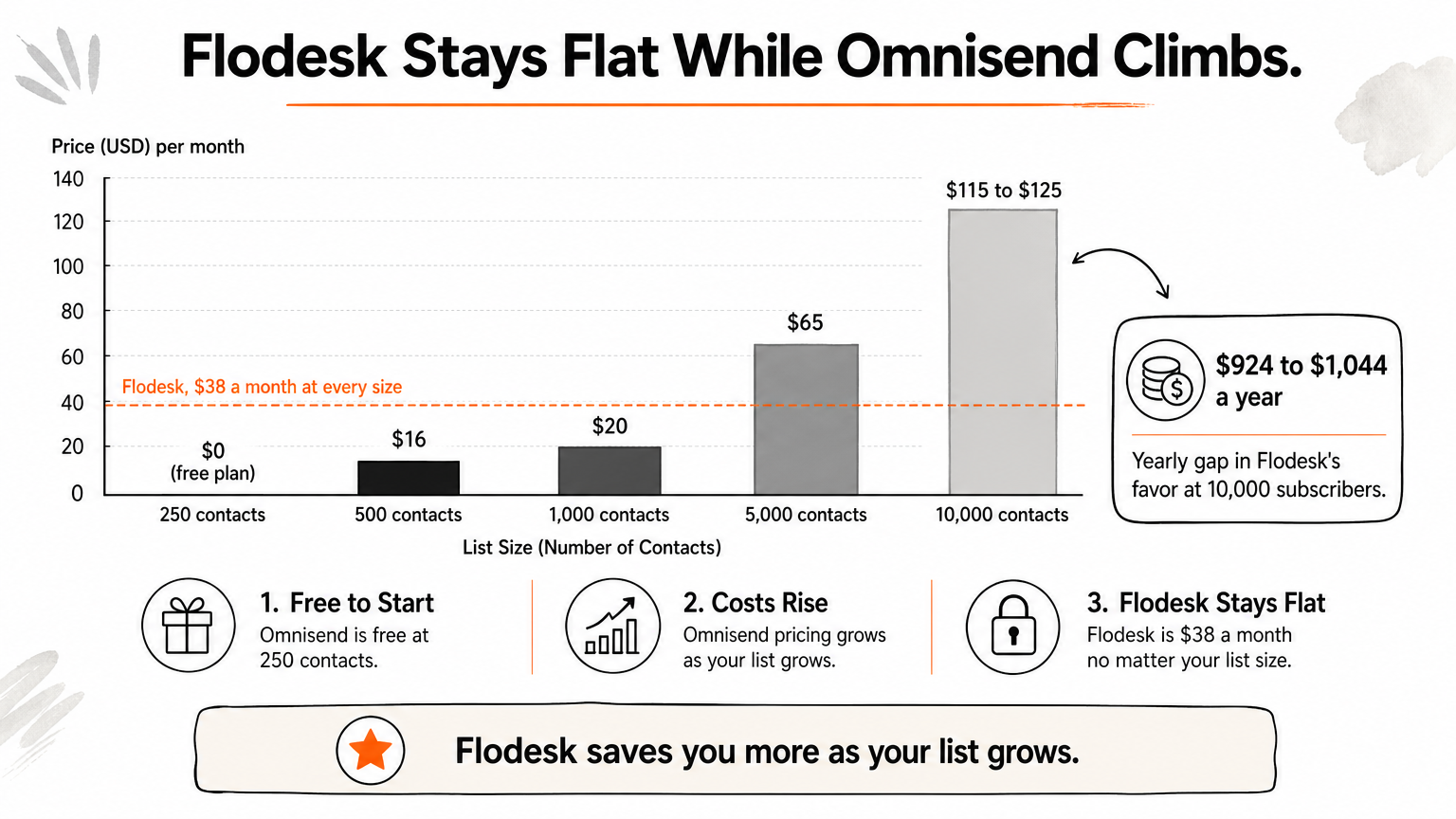
Flodesk costs less once you pass roughly 2,000 to 3,000 contacts, and Omnisend costs less below that. Flodesk charges a flat $38 a month for email with unlimited subscribers, while Omnisend's price scales with contact count.
Flodesk's take
On the free plan you get forms, popups, landing pages and segmentation for unlimited contacts, but you cannot send marketing email. To send, you add the Email plan after a 30-day trial. Because pricing never depends on list size, your cost stays predictable as you grow.
- Free: forms, popups, landing pages, unlimited contacts, no email sending
- Email, $38/month: unlimited subscribers and emails, workflows, send time optimizer, API access
- Email & Checkout: adds sales pages, upsells, discounts, checkout flows and payment processing (check Flodesk's pricing page for the current price)
Omnisend's take
Omnisend starts with a free plan for 250 contacts and 500 emails a month. Paid Standard plans begin at $16 a month, and the price rises with your list, with roughly 10 to 12 emails per contact included each month. Pro costs $59 a month for 2,500 contacts and adds advanced reporting and priority support. SMS is billed by message volume on top of the plan.
| Contacts | Flodesk Email plan | Omnisend Standard |
|---|---|---|
| 250 | $38 | $0 (free plan) |
| 500 | $38 | $16 |
| 1,000 | $38 | $20 |
| 5,000 | $38 | $65 |
| 10,000 | $38 | About $115 to $125 |
Published tiers shift over time, so confirm the current figures on each pricing page before you commit.
The verdict
Take a store with 10,000 subscribers. Flodesk costs $456 a year. Omnisend costs roughly $1,380 to $1,500, a gap of about $924 to $1,044. At 1,000 subscribers the order flips: Omnisend costs $240 a year against Flodesk's $456. Forum threads comparing the two usually start with exactly this gap.
That gap is only worth paying if Omnisend earns it back. One cart-recovery flow that recovers $1,000 a year erases it. A newsletter-only sender will never recover it.
Flodesk wins on price per subscriber, and Omnisend wins only when the extra cost buys revenue-driving automation.
2. Email design and templates
Flodesk wins on pure visual design. Omnisend wins when the email has to pull live product data into the layout.

Flodesk's take
Flodesk is built around design. Its templates look high-end, its drag-and-drop editor is simple, and its forms and landing pages match your brand styling. Flodesk Studio can also generate an email design from a text prompt. Reviewers often say they got a premium look without hiring a designer.
- Strong for editorial, lifestyle and launch emails
- Forms and landing pages share the same look as your emails
- Not built to fill emails with catalog data from a store
Omnisend's take
Omnisend's builder is clean and quick, with a template library that includes seasonal designs, and you can upload your own HTML. Its Product Picker lets you drag items into an email, up to 8 products across 4 columns, and you choose which details show: image, title, description, price, old price and button. A Product Recommender can fill an email with your newest products automatically. An AI assistant and subject line generator are included on every plan.
- Product blocks pull live prices and images from your store
- A "Quick Add" section speeds up repeat content blocks
- Templates are functional rather than showpiece
The verdict
Design talent matters more than the builder. A template is a starting point, but emails that convert for a store usually need custom layouts tied to the brand and the offer. We design without templates for that reason, and the builder only has to execute the layout.
Still, the builders differ in what they are good at. Pick Flodesk if the email itself is your brand showcase. Pick Omnisend if the email is mostly a window into your catalog.
Flodesk makes the prettiest newsletter, but Omnisend makes the more useful product email.
3. Automation and workflows
Omnisend wins automation for stores by a wide margin. Flodesk workflows cover simple welcome and nurture sequences, but behavior-based triggers and in-flow testing are where it runs out of room.
Flodesk's take
Flodesk includes workflows on its Email plan, along with a send time optimizer and personalization fields. That is enough for a welcome series or a course drip. It is not built around store events such as carts, browsing and orders, and the workflow builder offers limited branching compared with ecommerce platforms.
- Fine for: welcome series, onboarding drips, launch sequences
- Thin on: abandoned cart, browse abandonment, post-purchase flows tied to what was bought
- Missing: A/B testing inside campaigns
Omnisend's take
Omnisend ships pre-built workflows, so you can start from a working structure instead of a blank canvas. You can trigger flows on opened or clicked messages, and Shopify and API-connected stores get order-event triggers. A retroactive option lets a new workflow include customers who already placed orders. Flows can mix email, SMS and push in one sequence.
- Welcome
- Cart abandonment
- Browse abandonment
- Post-purchase
- Special occasions
- Transactional
The verdict
Automations carry most of the revenue in a healthy ecommerce email program. For one niche tech brand we work with, automations contributed $1.1M of the $1.6M in email-attributed revenue over ten months. That is why we build the flows first and layer campaigns on top.
Flodesk cannot build most of those flows natively. If your store depends on cart, browse and post-purchase sequences, Flodesk is the wrong tool.
If abandoned cart and post-purchase flows matter to you, the Flodesk vs Omnisend decision is already made.
4. Ecommerce and store features
Omnisend is built for ecommerce. Flodesk is built for creators, with a checkout add-on that suits digital products rather than a physical catalog.
Flodesk's take
The Email & Checkout plan adds sales pages, upsells and bonus offers, discounts, checkout flows and payment processing. That works for coaches, course creators and anyone selling digital offers. It does not sync a physical store's catalog, orders and carts the way a store-first platform does, and connections to other store platforms typically run through Zapier.
- Best fit: courses, templates, bookings, memberships
- Checkout lives inside the email tool
- Physical stores need a workaround for order and cart data
Omnisend's take
Omnisend connects natively to Shopify, WooCommerce, BigCommerce, Magento, OpenCart and PrestaShop. Its Shopify app holds a rating of about 4.7 out of 5. That sync powers cart and browse abandonment, product blocks, purchase-based segments and revenue reporting. Popups can also offer discounts, including a gamified Wheel of Fortune form.
- Customer, order and product data flows in automatically
- Reports attribute sales to email, SMS and push
- No checkout feature, since your store handles payment
The verdict
| Store need | Flodesk | Omnisend |
|---|---|---|
| Native store sync | Limited, often via Zapier | Yes |
| Cart and browse abandonment | Not a focus | Yes |
| Product blocks in emails | No | Yes |
| Revenue shown in reports | Basic | Yes |
| Digital product checkout | Yes (Email & Checkout) | No, your store handles it |
For a physical product store, the table is lopsided. For a creator selling a course, the last row can tip the decision to Flodesk, since checkout and email sit under one login.
Omnisend understands your store, while Flodesk understands your content.
5. SMS and push channels
Omnisend sends email, SMS and push from one platform. Flodesk is email-first, so text messages usually come from a separate tool.

Flodesk's take
Comparisons consistently describe Flodesk as an email product without native SMS or push. If you want texts, you connect another SMS platform, often through Zapier. The cost is not the subscription. It is the split audience, because you now keep two lists, two sets of consent records and two reports.
- No shared cross-channel flows
- Consent and unsubscribes live in separate systems
- Results are reported separately
Omnisend's take
Omnisend treats email, SMS and push as channels inside one workflow. A cart reminder can start as an email, wait, then send a text to people who did not click. Reports track sales per channel, so you can see what SMS adds beyond email.
- Shopper abandons cart, email goes out after a short delay
- Workflow waits, then checks whether the shopper clicked
- If not, an SMS reminder goes out
- Push notification is optional for subscribers who allowed it
The verdict
SMS needs its own explicit consent, separate from email, so add a text opt-in to your signup form. In the US, text marketing rules are stricter than email rules, so collect consent properly from day one. We build SMS as a supporting layer, with automations first and eligible SMS flows and campaigns reinforcing them.
If SMS is on your 12-month roadmap, Omnisend saves you a platform and a lot of data stitching. If you only send email and have no store, Flodesk's lack of SMS costs you nothing.
Add SMS after your flows work, because text amplifies a good flow and cannot rescue a weak one.
6. Segmentation, forms and list growth
Omnisend segments on purchase and engagement behavior. Flodesk's segments are simpler, though its free forms and popups are a real advantage for list building.
Flodesk's take
Even the free plan includes forms, popups, landing pages and segmentation for unlimited contacts. You can start growing a list before paying anything. Its developer documentation describes segments as named groups that you add subscribers to, rather than rules that update on their own from purchase data.
- Forms and landing pages match your email design
- Free to collect contacts, paid only to send
- No automatic filtering by order history
Omnisend's take
Omnisend offers unlimited segments across several categories, and you can layer them. All plans include forms, popups and landing pages, with templates for seasonal offers and the Wheel of Fortune spin-to-win form. You can add checkboxes to collect extra data for sharper segments.
- Orders and products: browsed, added to cart or purchased in the last 30 days
- Engagement: opens and clicks
- Contact properties: name, birthday, location
- Recommended: prebuilt segments such as opened message or placed order
The verdict
Either tool captures an email address. The difference is what happens next. A segment such as "bought in the last 30 days and opened the last campaign" takes seconds in Omnisend and is hard to replicate in Flodesk.
Segmentation matters because relevance lifts every flow and campaign. A strong signup form with a clear offer feeds a welcome flow, and the welcome flow only pays off if later emails go to the right people. If you want rule-based targeting, you want Omnisend or Klaviyo.
Flodesk helps you collect subscribers, and Omnisend helps you decide who should get which email.
7. Reporting, testing and deliverability
Omnisend gives you revenue reporting and basic testing. Flodesk's analytics are basic and it has no A/B testing. Neither goes as deep as Klaviyo.
Flodesk's take
Flodesk reports the essentials such as opens and clicks, but you will not find revenue attribution tied to store orders. There is no A/B testing, so you cannot split-test a subject line against another. For a creator who sends one newsletter a week, that may be fine. For a store trying to lift revenue per send, it is a ceiling.
- Basic engagement reporting
- No head-to-head testing
- No order-level revenue view
Omnisend's take
Omnisend's reports show a click map, open and click rates, revenue, unsubscribe rate and deliverability issues. The limits are worth knowing. Advanced reporting sits on the Pro plan, history covers the past 18 months, and A/B testing is mostly limited to subject lines and sender names. For deliverability it covers authentication, spam complaint handling and bounce management, though not a full deliverability dashboard.
- Sales tracked across email, SMS and push
- Testing is useful but narrow
- Strong enough for most small and mid-size stores
The verdict
Testing compounds revenue. We test every part of an email system over time, including subject lines, offers, send timing, flow delays and signup forms. Omnisend supports part of that work. Flodesk supports almost none of it.
Be realistic about the ceiling. If you outgrow Omnisend's testing and reporting, Klaviyo is the usual next step. For most stores below that point, Omnisend is enough.
Flodesk cannot test and Omnisend can test a little, so stores that live on optimization should plan for a deeper tool later.
8. Integrations, support and ease of use
Flodesk is the easiest to learn and earns praise for support. Omnisend has many more integrations and offers 24/7 support on every plan.
Flodesk's take
Flodesk keeps the interface simple, and that is a big part of why creators like it. Trustpilot showed about 4.9 out of 5 from roughly 364 reviews at last check, with reviewers praising fast, personal support. The tradeoff is fewer native integrations, which means Zapier fills many gaps.
- Very short learning curve
- Support praised in reviews
- Thin integration list
Omnisend's take
Omnisend lists more than 300 integrations across store platforms, shipping, CRMs, reviews and support tools. It offers 24/7 email and live chat support even on the free plan, plus Omnisend Academy for learning material. Trustpilot showed about 4.4 out of 5 from roughly 508 reviews at last check, a good score for a tool with far more moving parts.
- Broad integration coverage
- Support on every plan
- A longer learning curve than Flodesk, though still manageable
The verdict
If you are a solo creator who wants to send something good in 20 minutes, Flodesk feels better. If you have a store stack of reviews, loyalty, subscriptions and shipping apps, Omnisend plugs into more of it. The review scores reflect that. A tool with fewer features has fewer ways to frustrate people.
Check your must-have integrations before you decide. A missing connection to your review app or subscription tool matters more than any feature on a comparison chart.
Flodesk is easier to use, and Omnisend is easier to connect.
How to choose between Flodesk and Omnisend
Choose by revenue model. If you sell content, services or digital offers, Flodesk fits. If you sell a catalog of products, Omnisend fits.
Pick Flodesk if
Flodesk fits creators, coaches, photographers, boutiques and service businesses with a large list and modest automation needs. You get beauty, simplicity and a flat price. Weigh its downsides before you commit:
- Basic automation with few behavior-based triggers
- Basic segmentation
- No A/B testing
- Fewer integrations
- The free plan cannot send marketing email
Pick Omnisend if
Omnisend is a good tool for small to mid-size stores that want cart recovery, product-based email, SMS and clear revenue reporting without Klaviyo's price. Its weaknesses are a price that climbs with your list, narrow testing and advanced reports reserved for Pro. As an official Omnisend partner, Chromex can point you to a partner sign-up link that has offered 20% off the first 2 months as cashback, and we confirm platform fit on a call.
When neither is the right fit
If you want deeper segmentation, predictive analytics and richer testing, Klaviyo is stronger, at a higher price. We also build on Klaviyo, so we see where it earns that cost. Creators monetizing a newsletter may prefer Kit, and MailerLite or Mailchimp are broader low-cost options. If you are a store and Flodesk is on your shortlist only because of price, run the 10,000-subscriber math from section 1 against what one good abandoned cart flow earns.
Making the call
Flodesk is the better value for design-led senders with big lists and simple needs. Omnisend is the better engine for stores that need flows, product data, segmentation and SMS. Price decides it only when automation does not matter to your revenue.
If you run a store and want email to become a major revenue channel, the platform is only half the answer. The flows, the design, the testing and the reporting are what make it pay. If you want help building that on Omnisend or Klaviyo, book a strategy call with Chromex Marketing and we will tell you honestly which setup fits your store.