Klaviyo vs Mailchimp: Pricing, Features, and Shopify Fit
Picking between Klaviyo and Mailchimp looks simple until you hit the pricing pages. Both send email, both connect to Shopify, and both promise growth. But the choice shapes how your flows, segments, and reporting work for years, and migrating later is a real headache. If you run an online store, klaviyo vs mailchimp is a decision worth getting right the first time.
Here is the short answer. For most ecommerce brands, Klaviyo is the better fit because it pulls in Shopify data like orders, browsing activity, and product views and lets you segment and automate on it. Mailchimp is easier and cheaper to start with, which suits very small lists and simple newsletters. Once revenue depends on flows like abandoned cart and post-purchase, Klaviyo usually pulls ahead.
Below, we compare pricing at different list sizes, core features, ease of use, and how each platform works with Shopify. At CHROMEX, we build and run email and SMS programs for ecommerce brands every day, so this comes from hands-on work, not spec sheets.
Why the Klaviyo vs Mailchimp choice matters
Email is the one channel you own. Ad costs keep climbing, and email is where you earn back the traffic you already paid for. At CHROMEX, email drives an average of 45% of our clients' monthly revenue, and one brand reached nearly 70%. That only happens when the platform underneath can act on your customer data.
The platform sets your ceiling
Every flow you build depends on what the platform knows about your shoppers. Klaviyo was built for ecommerce, so it treats orders, product views, and cart activity as core data. Mailchimp started as a newsletter tool and added store features later. That history explains most of the differences in any mailchimp vs klaviyo comparison.
Take a simple example. You want to email customers who bought a moisturizer 45 days ago and never reordered. In Klaviyo, that is a segment plus a flow trigger, and you can build it in minutes. In Mailchimp, you can get close, but the product-level filters are thinner and you work around gaps. The difference shows up in revenue, not in the feature list. Over a year, that gap decides whether replenishment, win-back, and cross-sell emails run at all.
Your email platform decides which customer data you can act on, and that decides how much revenue email can earn.
A quick map of the differences
Before the detail, here is the high-level split between the two platforms. Treat it as a map, not a verdict, because later sections cover each row in depth.
Klaviyo | Mailchimp | |
|---|---|---|
Built for | Ecommerce brands | Newsletters and general small business marketing |
Store data in segments and flows | Orders, products, and browsing events used directly | Core purchase data, thinner product-level filters |
Pricing basis | Active profiles | Contacts in your audience |
Best fit | Stores where email drives repeat revenue | Small lists and simple sends |
What a wrong choice costs
Switching later is where the real cost sits. You rebuild flows, redo sign-up forms, remap segments, and risk deliverability dips while your sending reputation settles on the new setup. Stores that migrate in a rush often have revenue-driving flows offline for days or longer, and that is money you do not get back.
Staying with the wrong tool costs more quietly. A store with email under 10% of revenue often has a platform problem and a strategy problem at once. The right pick gives you room to grow toward 30 to 60% of revenue from email without changing tools. That is why a klaviyo vs mailchimp for Shopify decision deserves a careful comparison, and the next section shows how to run one.
How to choose between Klaviyo and Mailchimp
Start with your store, not the feature list. The klaviyo vs mailchimp choice usually comes down to how much revenue you expect email to earn and how much customer data you want to act on. Run your store through the questions below and the answer usually shows itself.
Five questions that settle most cases
Answer these honestly. Each one points toward one platform.
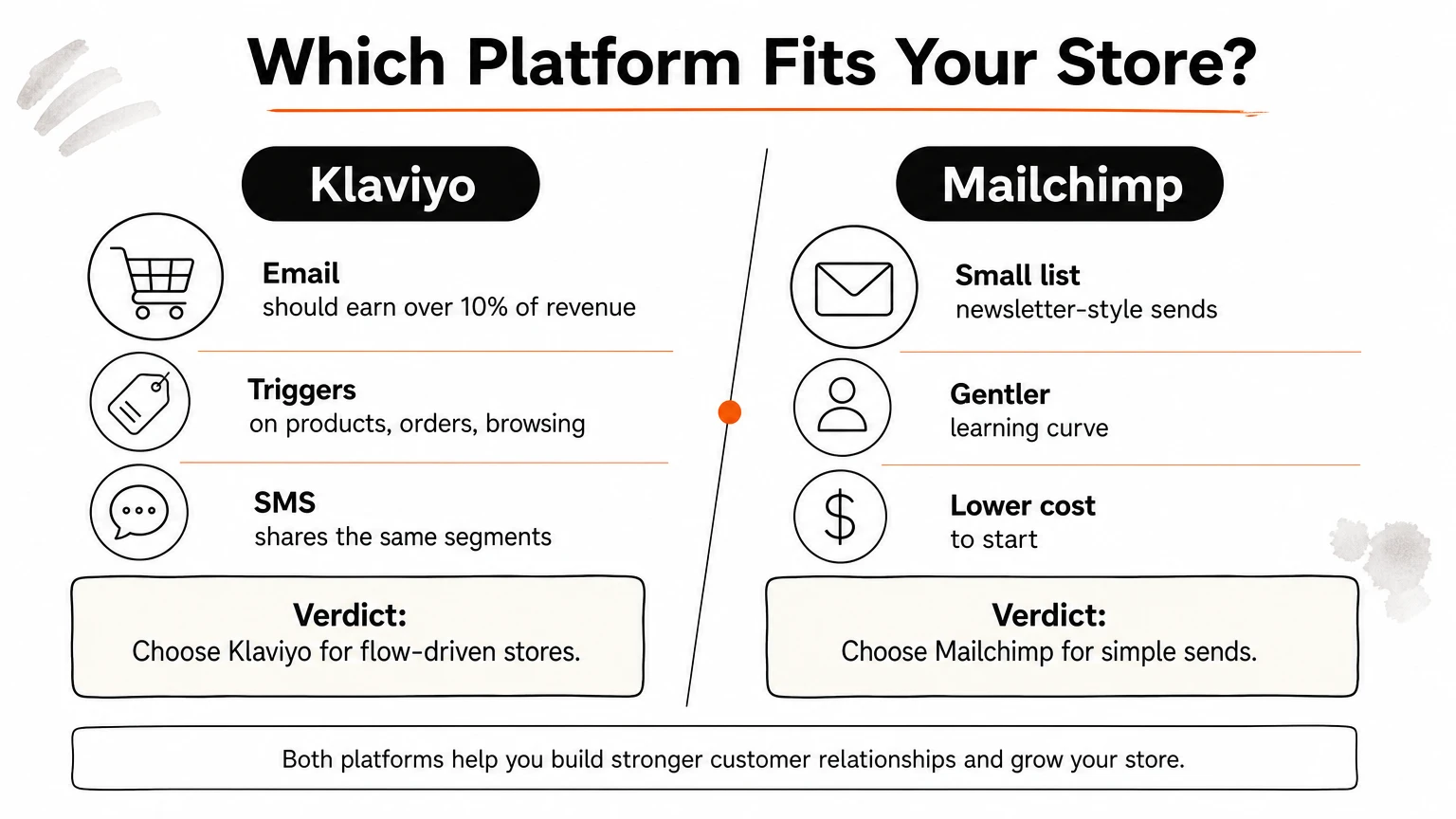
Should email drive more than 10% of your revenue within a year? If yes, lean Klaviyo.
Do you want triggers based on products, order history, or browsing? Klaviyo handles this natively.
Is your list small, with mostly newsletter-style sends? Mailchimp fits.
Will you add SMS to the same segments and flows? Klaviyo keeps both channels in one place.
Does your team have time to learn a more data-heavy tool? If not, Mailchimp is gentler.
Count your answers. If three or more point to Klaviyo, choose it, even when Mailchimp looks cheaper today. The price gap is small next to the revenue from flows you could not build any other way.
If email should earn repeat revenue, pick the platform built around your store data.
When Mailchimp is the right call
Mailchimp earns its place in specific situations. A new store with a few hundred subscribers, one monthly newsletter, and no automation plans does not need Klaviyo's depth. Simple sends and a shorter learning curve are real advantages when you are validating a product, not scaling a program.
Whatever you lean toward, test before you commit. Open an account on each platform, connect your Shopify store, and build the same two things: an abandoned cart flow and a segment of repeat buyers. The tool that gets you to the result with less workaround wins. Twenty minutes of side-by-side building in a mailchimp vs klaviyo Shopify trial tells you more than any comparison chart, including the table above.
Klaviyo vs Mailchimp pricing at different list sizes
Sticker prices mislead when you compare them without context. Klaviyo bills by active profiles, while Mailchimp bills by contacts stored in your audience. The units differ, so the same list can cost different amounts on each platform. Run your real numbers through both pricing calculators before you decide.
Approximate monthly cost by list size
The pattern matters more than the exact dollar figure. Both vendors change plans often, so treat the numbers below as rough guides and confirm them on the official pricing pages.
List size | Klaviyo (email) | Mailchimp |
|---|---|---|
Under 250 profiles | Free plan with a monthly send cap | Limited free plan |
About 500 | Around $20 | Roughly $13 to $20, depending on plan |
About 5,000 | Around $100 | Same ballpark on Standard, far higher on Premium |
10,000 and up | Around $150 and climbing | Climbs with contacts and plan tier |
At small sizes, a klaviyo vs mailchimp pricing check shows almost no gap. Cost differences grow as your list grows and as you need more advanced features.
What the sticker price hides
Plan gating is the first catch. Mailchimp splits features across Essentials, Standard, and Premium, so the automations you want may sit on a pricier tier. Klaviyo gives you its core flow and segmentation tools on every paid email plan, which makes the klaviyo pricing vs mailchimp math easier to predict.
SMS is the second catch. Klaviyo sells SMS credits separately from email, so budget for them if you plan to text customers. Also, clean your list before you compare. Unengaged and unsubscribed contacts can inflate what you pay on either platform, and suppressing them often cuts the bill noticeably.
Finally, judge cost against revenue, not against the invoice. A $50 monthly difference disappears if abandoned cart and post-purchase flows add even a few thousand dollars a month. That is why a mailchimp vs klaviyo pricing decision should start with what you want email to earn.
The cheaper platform is the one that earns back more than it costs, not the one with the lower invoice.
If your list is small and your sends are simple, Mailchimp's lower entry price is a fair reason to choose it. Once flows drive your revenue, pay for the data depth and expect the return to outweigh the gap.
Features compared: segmentation, flows, and analytics
Features decide whether the pricing math pays off. These are the three areas that move ecommerce revenue most, and the gaps between the platforms are clearest here.
Segmentation
Segmentation is where Klaviyo pulls ahead in a klaviyo vs mailchimp test. You can filter by what someone bought, which products they viewed, how often they order, and when they are likely to order next, all from live Shopify events. Mailchimp segments on purchase totals, tags, and activity, but product-level and behavior filters are thinner.
Try a real test. Build a segment of shoppers who viewed one product twice in 30 days and never bought it. Klaviyo handles that directly. In Mailchimp you will probably settle for a rougher approximation built from tags and site activity.
Segmentation depth, not email design, is the feature gap that shows up in your revenue.
Flows
Both platforms offer visual automation builders. Klaviyo ships with ready-made ecommerce flows for abandoned cart, browse abandonment, welcome series, post-purchase, and win-back, plus conditional splits based on order data. Mailchimp's Customer Journey Builder works well for simple sequences, but branching on product and order details is more limited.
Analytics
Reporting follows the same pattern. Klaviyo ties revenue to each flow, campaign, and email, so you see which message earns money and which only earns opens. Mailchimp reports opens, clicks, and sales, but you spend more effort connecting those numbers to specific flows and segments that drive repeat purchases.
Quick scorecard
Use this table as a scan, then judge it against your own flow plan.
Feature | Klaviyo | Mailchimp |
|---|---|---|
Product and browsing segments | Strong, native | Limited |
Prebuilt ecommerce flows | Broad library | Fewer, simpler |
Revenue attribution by flow | Detailed | Basic |
Ease of learning | Steeper | Gentler |
Which platform fits Shopify and ecommerce stores best
Shopify stores get the clearest answer in this comparison. In a klaviyo vs mailchimp Shopify test, Klaviyo's native integration wins on data depth, while Mailchimp covers the basics well enough for small, simple programs.
What syncs from Shopify
Both platforms install as Shopify apps and sync customers, orders, and products. The difference is what happens next. Klaviyo turns store activity into real-time events, such as viewed product, added to cart, started checkout, and placed order, then lets you trigger flows and build segments from each one. Mailchimp's sync is useful, but event-level triggers are fewer.
After you connect either tool, run this quick check:
Do browse and cart events show up on a customer profile within minutes?
Can you filter by a specific product or collection?
Does the abandoned cart email pull in product images and a working cart link?
Is revenue credited to each flow and campaign?
Do Shopify sign-up forms tag new subscribers correctly?
Where stores feel the difference
Replenishment is the clearest case. A store selling supplements, coffee, or skincare can email buyers when a product should run out. Klaviyo estimates the next order date and lets you trigger a flow from it. In Mailchimp you build that timing by hand, if you build it at all.

Post-purchase works the same way. You can split by first-time versus repeat buyers, product category, or order value, and send different follow-ups to each group. Stores that pay for traffic also gain from browse abandonment, which reaches visitors who never made it to the cart.
For a Shopify store, the better platform is the one that turns store events into emails without workarounds.
Our verdict for Shopify
Our take is simple. If you run a Shopify store with real traffic, choose Klaviyo. A mailchimp vs klaviyo for Shopify decision only tips toward Mailchimp when your list is tiny and your sends are plain newsletters. We build ecommerce flows every day at CHROMEX, and stores with event-based flows pull ahead quickly.
Already on Mailchimp? Migrate in stages. Rebuild the abandoned cart and welcome flows first, keep the rest live, and move the remaining flows once your sending reputation holds steady on the new platform.
What users say, plus how HubSpot and others compare
Opinions help once you know the specs. Still, user feedback needs a filter, because people judge tools by their own store size and skill level.
What Reddit and review threads say
Search klaviyo vs mailchimp reddit and the same themes repeat. Store owners praise Klaviyo's segmentation and revenue reporting, and they complain about price jumps as profiles grow. Mailchimp gets credit for being easy to use, and criticism for thin ecommerce data and plan limits that push you up a tier.
Treat those threads with care. A mailchimp vs klaviyo reddit post from 2023 may describe plans that have since changed, and many posters run tiny lists or no flows at all. Weight feedback from stores your size, and check the post date before you trust any pricing claim.
Trust reviews from people whose list size, platform, and goals match yours.
How HubSpot and other options compare
Klaviyo vs mailchimp vs hubspot is really a different question. HubSpot is a full CRM with marketing, sales, and service tools. It fits B2B and service businesses that want leads and deals in one system. For an online store, its email costs climb quickly as contacts grow, and its ecommerce depth trails Klaviyo.
Platform | Best for | Trade-off |
|---|---|---|
Klaviyo | Shopify stores that run on flows | Steeper learning curve |
Mailchimp | Small lists, simple newsletters | Thin product-level data |
HubSpot | B2B and CRM-led teams | Costly, less ecommerce depth |
Omnisend | Stores that want email and SMS together | Less advanced segmentation than Klaviyo |
We work in Klaviyo and Omnisend every week. Omnisend is a solid middle path for stores that want ecommerce automation with a gentler setup. If your plan leans on deep segmentation and detailed attribution, Klaviyo is still the stronger pick.
Making the call for your store
The klaviyo vs mailchimp question comes down to what you want email to earn. If your store has real traffic and you want flows, segments, and revenue reporting to drive repeat orders, Klaviyo is the stronger choice. If your list is tiny and your sends are simple newsletters, Mailchimp is a fair, cheaper start. The price gap is small next to the revenue that event-based flows produce.
Whichever you pick, the platform is only half the work. Strategy, flow design, testing, and deliverability decide how much revenue you actually get from it. If you would rather hand that work to specialists, book a call with CHROMEX. We will audit your current setup, build the flows that matter, and make email a major revenue channel for your store.