6 Best Omnisend Alternatives for Ecommerce Stores in 2026
The best Omnisend alternative depends on why you want to leave. Klaviyo suits stores that want deep data and can pay for it. Brevo and MailerLite suit tight budgets. ActiveCampaign suits teams with complex customer journeys, and Drip suits ecommerce teams that want revenue reporting built in. Mailchimp suits stores that mix newsletters with light automation.
Most people start looking at alternatives to Omnisend for the same few reasons. The free plan reaches only 250 contacts and 500 emails a month, costs climb as your list grows, or the automation and SMS setup no longer matches how the store sells. A new tool fixes some of that. It also costs you migration time and rebuilt flows, so you want to get the choice right the first time.
This article compares six platforms on ecommerce integration, automation depth, price at 10,000 contacts, and free-plan limits. Chromex Marketing manages email and SMS programs for ecommerce brands and is an official Omnisend partner. We see how these platforms behave in real stores, not just on feature pages.
Omnisend alternatives compared at a glance
Four of the six alternatives below offer a free plan. The two that do not, ActiveCampaign and Drip, offer free trials instead. The table sets entry prices and free limits side by side, with Omnisend as the baseline.
Price and free-plan limits side by side
| Platform | Best for | Free plan | Paid plans start at |
|---|---|---|---|
| Omnisend (baseline) | Email and SMS for stores | 250 contacts reachable, 500 emails a month | $16/mo Standard |
| Klaviyo | Data-heavy stores | 250 profiles | $20/mo (500 contacts) |
| Mailchimp | Newsletters plus light automation | 250 contacts, 500 emails a month | $13/mo Essentials |
| Brevo | Tight budgets, transactional email | 300 emails a day | $9/mo Starter |
| MailerLite | Simple, low-cost email | 500 subscribers | $10/mo Growing Business |
| ActiveCampaign | Advanced automation | None, free trial | $15/mo billed annually (1,000 contacts) |
| Drip | Ecommerce revenue focus | None, 14-day trial | $39/mo (up to 2,500 people) |
Prices are list prices at the time of writing and change often, so confirm them on each vendor's pricing page. The type of free limit matters more than its size. Brevo caps sends per day, so a store with 10,000 subscribers needs about 34 days at 300 emails a day to mail everyone once. Mailchimp cut its free plan back in early 2026, though older guides still quote 500 contacts.
What a 10,000-contact store pays
Take a store with 10,000 contacts. Omnisend Standard lists at $132 a month, Klaviyo at about $150, and Mailchimp Essentials at $110. Moving to Klaviyo adds $18 a month, or $216 a year. Moving to Mailchimp saves $22 a month, or $264 a year.
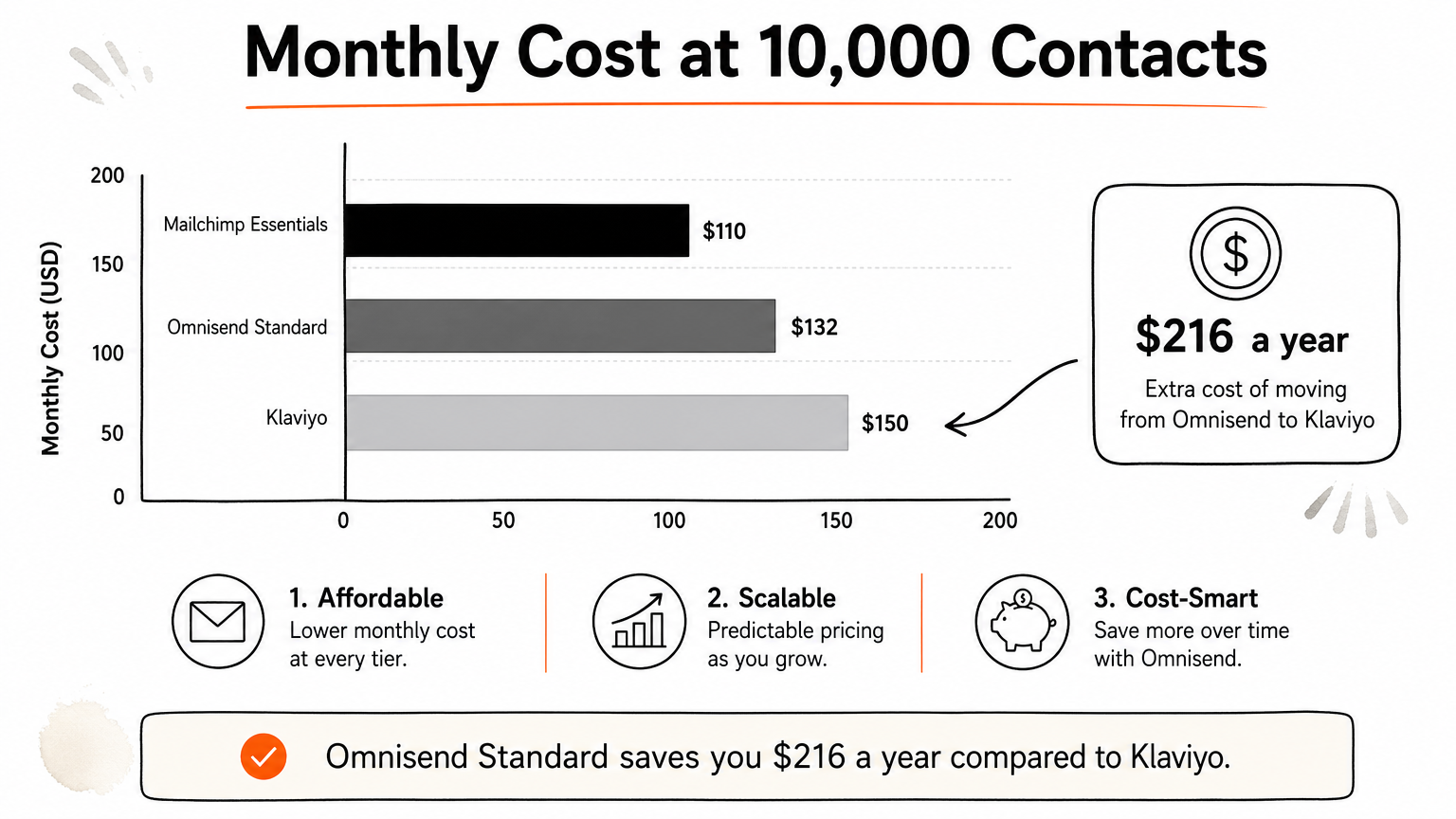
The Mailchimp saving is not like for like. Essentials has no conditional branching in automations, and most stores need branching for cart and browse flows. The Standard plan adds it, but starts at $20 a month against $13 for Essentials. Compare plans by the automations you need, not by the headline price.
How to pick, and when the platform is not the problem
Pick on three things. First, check the integration with your store platform, since support for Shopify, WooCommerce and BigCommerce varies by tool. Second, match the tool to the person running it. A strong in-house marketer can use Klaviyo or ActiveCampaign, while a founder working alone moves faster in something simpler. Third, if SMS matters, confirm which plan includes it and how it is billed. Reviewers note that Mailchimp offers SMS only on higher plans or as add-ons.
Then ask whether the platform is really the problem. We are an official Omnisend partner and also work in Klaviyo, so we have no reason to push you either way. Weak results often trace back to missing flows, deliverability trouble or untested emails, and those follow you to a new tool. Our Analyze step audits all three in days 1 to 5 and ends with a 60-day action plan, which tells you whether to switch or fix.
A new platform will not repair flows that were weak on the old one.
1. Klaviyo: best for data-heavy stores
How it compares to Omnisend
Klaviyo is the closest like-for-like rival, and it goes deeper on data. You get predictive analytics, granular segmentation and strong revenue attribution, all tied closely to store platforms such as Shopify.
The catch is cost and complexity. Reviewers report that Klaviyo bills on every active profile in your database, not only the contacts you email, so the bill rises as the list grows. It also rewards teams with an in-house marketer or agency to work the reporting. Omnisend is simpler to learn and cheaper at the same list size.
Klaviyo gives you more data than most stores use, so pay for it only if someone will act on it.
Pricing and free plan
Klaviyo's free plan covers up to 250 profiles, and paid plans start at $20 a month for 500 contacts. The gap with Omnisend shows up as your list grows.
- Free plan: 250 profiles
- Entry paid plan: $20 a month for 500 contacts
- At 10,000 contacts: about $150 a month, against $132 for Omnisend Standard
Who it suits
Klaviyo fits larger stores with the budget and someone who can build segments and read the reports. If email already brings steady revenue, the extra analysis can pay for itself.
Skip it if you are a lean team without technical help, or if you want predictable costs while your list keeps growing.
2. Mailchimp: best for newsletters plus light automation
How it compares to Omnisend
Mailchimp is an all-rounder that began with newsletters, so ecommerce automation is not its strongest side. Independent side-by-side tests give Omnisend the edge on ecommerce automation and templates. They give Mailchimp the edge on reporting, landing pages and the sheer number of integrations. So if you are weighing Mailchimp against Omnisend, the split is store automation versus broader reporting.
Automations are also gated. Essentials has no conditional branching, while Omnisend includes automation on every plan. Mailchimp offers 100+ modern templates on Essentials and above, but the free plan's templates are basic.
Mailchimp is a strong all-rounder, but for store automation Omnisend is the better tool.
Pricing and free plan
Mailchimp looks cheapest on paper, which is the trap. Branching journeys need a plan above entry level.
- Free plan: 250 contacts and 500 emails a month, after the early 2026 cut
- Essentials: from $13 a month, about $110 at 10,000 contacts
- Standard: from $20 a month, adds branching automations
Who it suits
Mailchimp suits small stores that send regular newsletters alongside a few simple automations. It also suits teams that want a familiar tool with a large integration marketplace.
Look elsewhere if cart and browse flows or SMS are central to your revenue. Reviewers say SMS sits on higher plans or add-ons.
3. Brevo: best for tight budgets and transactional email
How it compares to Omnisend
Brevo, formerly Sendinblue, is the value pick on this list. It bills mostly by email volume, not list size, which helps if you keep a large list but send selectively. It also handles transactional email, such as order confirmations and receipts, well.
The trade-off is depth. Brevo's ecommerce automation and reporting are lighter than Omnisend's. A/B testing and advanced reporting sit on the Business plan and above, so the real cost is higher than the entry price suggests.
Brevo stretches a small budget furthest, as long as your flows stay simple.
Pricing and free plan
Brevo's free plan allows unlimited contacts but caps sending at a daily limit.
- Free plan: 300 emails a day to unlimited contacts
- Starter: from $9 a month
- Business: from $18 a month, with A/B testing and advanced reporting
Who it suits
Brevo works for cost-sensitive stores with big lists, or stores that need reliable transactional sending next to marketing email. Daily-volume pricing rewards a store that mails in measured bursts.
It is a weaker fit if you want revenue-led ecommerce flows and detailed attribution out of the box.
4. MailerLite: best for simple, low-cost email
How it compares to Omnisend
MailerLite earns its fans with a clean interface and prices that are hard to beat. You get a drag-and-drop editor, basic automation and landing pages, which is enough to run a welcome series and regular campaigns.
Simplicity is also the ceiling. MailerLite lacks the deep ecommerce integrations, behavioral triggers and revenue reporting that Omnisend offers, such as flows triggered by a product viewed or an order placed. Many stores treat it as a good first tool that they outgrow.
MailerLite is easy to run, and you will feel its limits as soon as your store needs behavioral flows.
Pricing and free plan
MailerLite's free plan counts subscribers, so it is easy to predict.
- Free plan: up to 500 subscribers
- Growing Business: from $10 a month
- Larger lists: check the price at your own subscriber count before you commit
Who it suits
MailerLite suits new stores, bloggers and small teams that want affordable email without complexity. It is quick to learn, so a solo founder can be live in an afternoon.
Pass on it if your store depends on cart and browse abandonment with revenue attribution, because that is where the platform thins out.
5. ActiveCampaign: best for advanced automation
How it compares to Omnisend

ActiveCampaign has one of the most flexible workflow builders on the market, and it includes CRM functionality without extra cost. If your customer journeys branch across several conditions, it handles that logic better than most.
It leans toward B2B and general marketing, so its ecommerce depth trails store-first tools. Features such as attribution and conditional content sit on higher tiers, and costs can climb as your list grows.
ActiveCampaign gives you automation power, but you build the ecommerce layer yourself.
Pricing and free plan
ActiveCampaign has no permanent free plan, so you test it on a trial.
- Free plan: none, free trial only
- Entry price: $15 a month billed annually, for 1,000 contacts
- Higher tiers: needed for attribution and conditional content
Who it suits
ActiveCampaign fits stores with complex, multi-step journeys, or businesses that sell to both consumers and other companies. It also helps if a sales team needs a CRM next to the email tool.
Skip it if you need standard store flows such as welcome, cart and win-back. A store-first platform gets you there faster.
6. Drip: best for ecommerce revenue focus
How it compares to Omnisend
Drip is an ecommerce marketing automation platform built around online stores. It syncs with Shopify, WooCommerce and BigCommerce, and its visual workflow builder supports branching, goals and split testing. Instead of stopping at opens and clicks, it reports Revenue Per Person, which shows which emails earn money.
Drip says every feature is included on every plan, which removes upgrade guesswork. The trade-offs are that it is not the cheapest option and has no free plan.
Drip suits stores that judge every email by the revenue it earns.
Pricing and free plan
Drip prices by the number of people on your list and offers a trial in place of a free plan.
- Free plan: none, 14-day free trial
- Entry price: $39 a month for up to 2,500 people
- Features: all included at every plan, according to Drip
Who it suits
Drip suits DTC and ecommerce brands that want store-level data and automation without a developer on staff. It rewards stores that already have steady traffic and want sharper segments.
Look elsewhere if you are a hobby store or send only a handful of emails a month. A freemium tool costs less.
Picking your next platform
Each platform here wins for a different store. Klaviyo wins on data, Brevo and MailerLite on price, Mailchimp on newsletters and reporting, ActiveCampaign on automation logic, and Drip on ecommerce revenue focus. Compare them at your own list size, check which free limit bites first, and run a trial before you migrate.
Remember that a platform change only helps if the flows, deliverability and testing behind it are sound. If you want specialists to audit your setup and tell you whether to switch or fix, see how Chromex Marketing audits and runs email and SMS programs for ecommerce brands.