Omnisend vs Klaviyo: Which Fits Your Shopify Store Best?
In the Omnisend vs Klaviyo decision, pick Omnisend if you run a small or mid-size store and want lower bills, email, SMS and web push in one workflow, and live support at any hour. Pick Klaviyo if you have a large list, a dedicated email team, and a need for predictive analytics, deeper segmentation and better-designed templates. At 10,000 contacts, Omnisend Standard lists at $132 a month and Klaviyo at $150.
Both tools are built for ecommerce, and on the surface they look alike. Both offer the same core flows, sign-up forms and Shopify sync. The differences show up on your invoice, in how much setup you need, and in how deep the customer data goes. That makes it easy to overpay for features you never touch, or to outgrow a tool six months after you commit.
This article compares the two in ten rounds, from pricing to migration, and then tells you who should choose which. Chromex runs email and SMS programs for ecommerce brands, so the notes below focus on what changes your results, not on feature checklists. Prices are 2026 list prices, so confirm them on each pricing page before you buy.
1. Pricing and free plans
Omnisend costs less than Klaviyo at every list size compared below, and the gap grows from $4 a month at 500 contacts to $110 a month at 20,000 contacts. That answers most Klaviyo vs Omnisend pricing questions, but list prices change, so check both pricing pages before you commit.
Omnisend
Three tiers make up Omnisend's pricing: free, Standard and Pro. The free plan covers 250 contacts, 500 emails a month and 500 web push notifications. Standard starts at $16 a month for 500 contacts and caps sends at 12 times your contact count. Pro, from $59 a month at 2,500 contacts, adds SMS and unlimited sends, plus advanced reporting, dynamic content and an AI product recommender.
Billing counts more people than you might expect. Omnisend charges for billable contacts, which include non-subscribers and exclude only unsubscribed ones, so a list full of checkout-only contacts costs real money.
Klaviyo
Klaviyo's free plan also covers 250 contacts and 500 emails a month, plus $5 of monthly SMS credit. Paid Email plans start at $20 a month for 500 contacts, with sends capped at 10 times your profile count. Klaviyo bills on active profiles, meaning anyone you can email, including non-opted-in checkout contacts unless you suppress them.
Suppress before you compare. Whichever tool you use, remove unengaged and unsubscribed profiles first, because both vendors bill on list size and a bloated list inflates either invoice.
Verdict
Omnisend wins on price, and the gap widens as your list grows. Take a store with 10,000 contacts: Omnisend Standard at $132 a month is $1,584 a year, Klaviyo at $150 is $1,800, so you save $216. At 20,000 contacts it is $3,180 against $4,500, a $1,320 difference.
Omnisend Standard is the cheaper email plan, but once you need SMS the real comparison is Pro against Klaviyo, and that one is nearly even.
| Contacts | Omnisend Standard | Omnisend Pro | Klaviyo Email |
|---|---|---|---|
| 500 | $16 | n/a | $20 |
| 1,000 | $20 | n/a | $30 |
| 2,500 | $44 | $59 | $60 |
| 5,000 | $81 | $90 | $100 |
| 10,000 | $132 | $150 | $150 |
| 20,000 | $265 | $375 | $375 |
If you need SMS, compare Pro instead of Standard, because Standard has no SMS. Pro sits at or just below Klaviyo's price at every tier above, so the savings shrink. What you get in return is unlimited sends, against Klaviyo's 100,000 at 10,000 contacts.
2. Ease of use and setup
Omnisend is easier to learn, and Klaviyo repays the effort once your data gets complicated. Both connect to a store in about five minutes, so the difference shows up afterward, in how many screens sit between you and a sent campaign.
Omnisend
The sidebar has just eight entries, and Campaigns, Automation, Forms and Store settings are one click away. You can sign up with Shopify, Google or email, and a step-by-step setup guide takes you from connecting the store to setting a brand style. Even the advanced features have a modest learning curve.
Klaviyo
Klaviyo's sidebar has 15 entries, six of them collapsible groups such as Audience, Content and Analytics. Its explanations and in-app guidance are thorough, which helps a complete beginner learn ecommerce email properly. The price is more navigation, and features like custom reports and predictive segments assume you understand your customer data.
Verdict
Omnisend takes this round for owners and small teams who run email alongside everything else. If nobody on your team owns email full time, a smaller menu matters more than any single feature. A dedicated marketer or agency will be comfortable in either tool, so Klaviyo's steeper curve costs them little.
For specialists ease of use is a tie, and for everyone else it is a clear win for Omnisend.
3. Shopify and store integrations
For a Shopify store, Klaviyo vs Omnisend is close to a draw on the sync itself. Both apps are rated around 4.7 to 4.8 out of 5 by thousands of reviewers, so choose by store size and complexity, not by whether the connection works.
Omnisend
Connect your store and Omnisend pulls in products, store styling, customers and order history, and its product picker reads your live catalog. It also has native apps for WooCommerce and BigCommerce and lists 305+ integrations. One feature stands out: you can manage up to 500 stores in a single account, with one-click switching and shared assets.
Klaviyo
Klaviyo's Shopify sync goes deeper. It records shipment updates, partial fulfillments, collection views and site searches, and writes custom properties back to Shopify as customer metafields. It lists 350+ integrations and also connects to Salesforce Commerce Cloud and Adobe Commerce. The tradeoff is that one account is meant for one store or brand, so a multi-store owner needs multiple accounts.
Verdict
Omnisend fits most Shopify stores, and it is the better choice if you run several storefronts. Klaviyo earns its place on Shopify Plus or when you want your email data flowing back into Shopify. Large stores default to Klaviyo for exactly that reason, and it is a fair one.
On Shopify the sync works well on both sides, so decide on store count and data needs, not on the app rating.
4. Email builder and templates
Klaviyo's templates look better, while Omnisend's builder is faster for ecommerce campaigns and starts you with more templates. Neither editor will make you fight to get a campaign out.

Omnisend
Omnisend offers 250+ templates, with a deep set of seasonal ones, and a drag-and-drop editor split into Elements, Products, Images, Header, Content and Footer. Product blocks can be static or dynamic, such as best-sellers, recently added or most viewed. AI text editing works even on the free plan, and A/B testing covers subject lines, sender names and content, with the winner sent to everyone else automatically. The design elements are fewer than Klaviyo's.
Klaviyo
Klaviyo's templates are widely regarded as some of the best designed in the category, and its editor adds blocks such as drop shadow, table and split. Product feeds update automatically (best sellers, recently viewed, personalized picks) and can be filtered per recipient. You set up feeds separately from the email, which takes more clicks. Campaign A/B tests cover content or send time.
Verdict
Klaviyo wins narrowly on design polish, and Omnisend wins on speed. A small team without a designer can ship professional-looking emails from Klaviyo's templates alone. Templates only go so far, though, and brands that want emails that look unmistakably their own end up needing custom design on either platform. Chromex designs every email without templates for that reason.
Klaviyo gives you the better-looking starting point, and Omnisend gets the campaign out the door sooner.
5. Email and SMS automation
Omnisend launches flows faster and mixes channels more easily, while Klaviyo offers finer triggers and filters. Both cover welcome, abandoned cart, browse abandonment, post-purchase and win-back flows, and that is where most store revenue comes from.
Omnisend
Omnisend ships 30+ pre-built workflows with recommended timing, filters and message templates. Email, SMS and web push are native steps in one workflow. If a contact has no SMS consent or you run out of credits, Omnisend sends an email instead of failing the flow. Each workflow takes up to five trigger filters, four exit conditions and ten conditional splits, and you can A/B test delays, channels and content inside it.
Klaviyo
Klaviyo has six trigger types: list, segment, metric, date property, price drop and low inventory. Its templates include back-in-stock, price drop and predicted next order flows. Profile filters are rechecked before every message, so a customer who orders mid-flow stops getting cart reminders. Channels are email, SMS and WhatsApp, with no web push, and adding SMS to a cart flow means building conditional splits to check consent.
Verdict
Omnisend is the better fit for most stores, because the omnichannel logic is built in and you can switch on proven flows in an afternoon. Klaviyo is the better fit if your flows depend on rich behavioral data or you want WhatsApp in the mix. Fewer, well-built flows beat a sprawling flow map on either tool.
Omnisend gets a working flow live sooner, and Klaviyo lets you aim that flow more precisely.
6. SMS marketing
Omnisend is cheaper per text and keeps SMS inside the same workflows as email, while Klaviyo is stronger at two-way conversations. Both treat SMS as a real channel. The rates below are U.S. list rates.
Omnisend
New customers get SMS on Pro. Bundles start at $10 a month at $0.009 per U.S. message, about 1,111 texts, and the rate falls to $0.0085 once you spend $50 a month and to $0.007 above $10,000 a month. Omnisend says it supports SMS in 190+ countries, and MMS works in the U.S. and Canada. Two-way replies only work through a Gorgias integration, for U.S. customers.
Klaviyo
SMS is available on every Klaviyo plan, including the free one with $5 of monthly credit, roughly 200 U.S. sends. Extra credits start at $15 a month at $0.011 per U.S. message, dropping to $0.008 at volume. Klaviyo also supports two-way conversations, keyword replies and conversational flows with surveys and quizzes. In Europe and Australia it uses branded sender IDs, which cannot receive replies.
Verdict
Omnisend wins on cost and Klaviyo wins on conversation. At entry rates, 5,000 U.S. texts cost about $45 on Omnisend and $55 on Klaviyo, before volume discounts and credits. Both vary credits by destination country, and MMS counts as three sends, so budget international texting with extra care.
Choose Omnisend if you send texts mainly as flow follow-ups, and Klaviyo if you want customers to text back.
| Omnisend | Klaviyo | |
|---|---|---|
| Plan needed | Pro (new customers) | Any plan |
| Entry bundle | $10 a month | $15 a month |
| U.S. rate at entry | $0.009 per message | $0.011 per message |
| Lowest published U.S. rate | $0.007 (above $10,000 a month) | $0.008 (by volume) |
| Two-way texting | Through Gorgias, U.S. customers | Built in where numbers support replies |
7. Segmentation, reporting, and AI
Klaviyo is the stronger analytics platform, and this is where its higher price buys something real. Omnisend covers the segments most stores actually send to, and its AI tools reach further down the pricing ladder.

Omnisend
Omnisend builds segments with AND/OR filters on purchase history, browsing, campaign engagement and subscription status, and it includes 30+ pre-built segments. Its AI segment builder turns a phrase like "big spenders who haven't bought lately" into an audience. Customer Breakdown sorts contacts by RFM lifecycle stage with churn prediction. CLV appears per contact but cannot drive a segment, and reports are fixed tabs, with advanced reporting on Pro.
Klaviyo
Klaviyo predicts next order date, lifetime value and churn risk, and you can segment directly on those predictions. It adds proximity filters, segment snapshots, benchmarks against similar businesses and custom reports built from five starting points. Its K:AI layer includes a Marketing Agent for planning campaigns and a Customer Agent for support. Content generation is metered by credits, and free-plan access is limited.
Verdict
Klaviyo wins this round, mostly for stores with large lists and someone who reads the data. Both tools use last-touch attribution, with Omnisend defaulting to seven days for email and 24 hours for SMS and push, and Klaviyo to five days for email and text. The practical gap is predictive targeting, which pays off at 50,000+ contacts and is easy to ignore below that.
Klaviyo's edge is in predicting who will buy next, and a store without time to act on that gets little from it.
8. Deliverability
Deliverability is close to even. Both give you the authentication and monitoring tools you need, and your sending habits matter more than the platform.
Omnisend
Omnisend requires a custom-domain sender and does not support free Gmail or Yahoo addresses. Domain signature (SPF and DKIM) is free, sending runs on shared IPs by default with no warm-up, and dedicated IPs suit senders above 300,000 emails a week. Reports show failures, spam and unsubscribes for your top 100 email domains, and list cleaning costs $0.20 per 100 contacts.
Klaviyo
Klaviyo's Deliverability Hub gives you health scores, an action center and performance by inbox provider across Gmail, Yahoo and Outlook. A branded sending domain is required for bulk senders, meaning 5,000+ emails a day to Gmail, and your from-address must align with it for DMARC. Built-in sunset flows phase out unengaged subscribers automatically.
Verdict
Klaviyo has a narrow edge because it automates more of the reputation work. Omnisend covers what most senders need. On either platform, the same habits protect your inbox placement:
- Authenticate your sending domain with SPF, DKIM and DMARC.
- Send first to recent engagers, such as contacts active in the last 30 days.
- Warm up a new domain or dedicated IP gradually.
- Suppress contacts who stopped engaging.
Neither platform will rescue a list that never engages, so tool choice matters less here than list hygiene.
9. Customer support
Omnisend wins support clearly. It offers 24/7 live chat and email on every plan, free included, while Klaviyo's free plan gets email support for 60 days only.
Omnisend
Round-the-clock live chat and email come with every plan, and a floating chat widget can hand you to a person on request. The help center holds 600+ articles, and Omnisend Academy is free. Pro customers on plans of $400 a month or more get a dedicated account expert.
Klaviyo
Paid plans include email and live chat. Urgent email issues get a response within four hours, while low-urgency requests can take up to 48 hours. Premium support is custom priced and extends chat hours, with 24/7 coverage at the Enterprise tier. Klaviyo's documentation is excellent, and more agencies and freelancers know the platform than any other ecommerce email tool.
Verdict
Choose Omnisend if you want to solve problems directly with the vendor at any hour. Choose Klaviyo if your model is to hire an expert to run the account, because the talent pool is deeper. Klaviyo's ecosystem is a real operational advantage, but it is not the same as support from the platform itself.
Omnisend gives you help from the vendor, and Klaviyo gives you a bigger market of people who can run it for you.
10. Switching platforms
Moving from Klaviyo to Omnisend is easier than most owners expect, because Omnisend runs a done-for-you migration. Moving the other way is largely self-serve.
Omnisend
Omnisend advertises a free migration from Klaviyo that rebuilds flows, lists, segments, templates and sign-up forms in about five business days. Confirm which plans qualify before you rely on it. The self-serve import tool moves emails, phone numbers, names, addresses, subscription statuses and consent records at 500 contacts every five seconds, so 10,000 contacts take about 100 seconds. Flows cannot be exported, so they get rebuilt by hand.
Klaviyo
Klaviyo's move-in help is mostly self-serve: CSV import, API connections and its documentation. You rebuild flows and templates yourself, so budget your own time or an agency's. Moving from Omnisend to Klaviyo is a normal project that large stores undertake as they grow, but nothing makes it painless.
Verdict
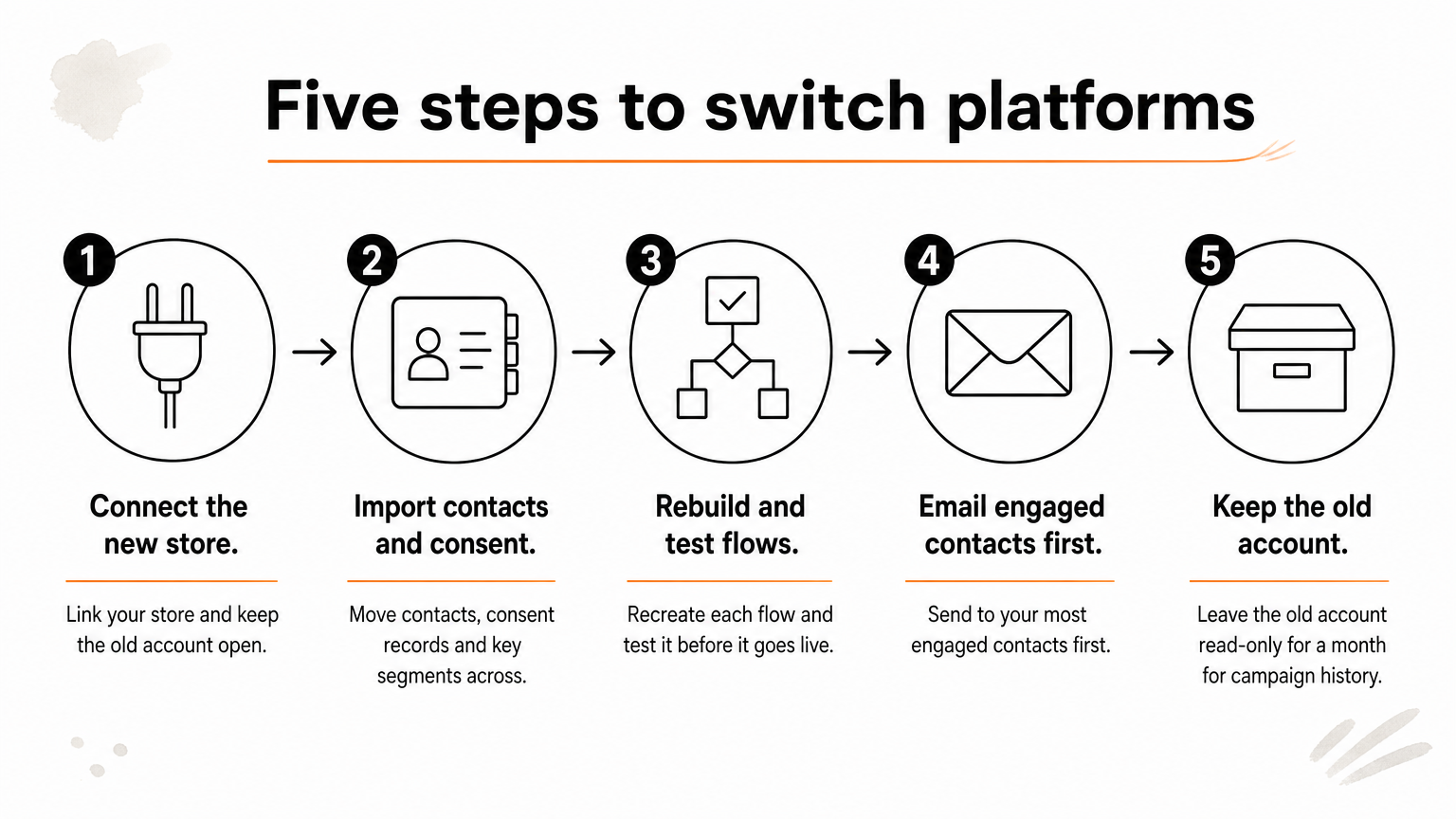
The switching cost is no longer a good reason to stay on a platform that does not fit. The safest sequence is the same in either direction:
- Connect your store to the new platform and leave the old account open.
- Import contacts, consent records and key segments.
- Rebuild your flows and test each one before it goes live.
- Email your most engaged contacts first to protect deliverability, running both tools in parallel.
- Keep the old account read-only for a month so you can still reach campaign history.
Switching used to be the reason stores stayed put, and a done-for-you migration removes most of that excuse.
Klaviyo or Omnisend: which one should you choose?
Choose Omnisend for most stores below roughly 50,000 contacts, and choose Klaviyo when data depth, Shopify Plus or agency support drives the decision. The scorecard below puts the ten rounds in one place.
Choose Omnisend if
- You want the lower monthly bill, especially above 5,000 contacts.
- Email, SMS and web push should live in one workflow.
- Nobody on your team owns email full time.
- You run multiple stores or want 24/7 live support.
- You are leaving Klaviyo and want help moving.
Choose Klaviyo if
- You have a large list and a team that will use predictive analytics.
- You are on Shopify Plus or want data written back to Shopify.
- You need WhatsApp, two-way SMS or richer flow filters.
- Design polish matters and you have no designer.
- You plan to hire an agency or freelancer who already knows the platform.
Scorecard
The tally favors Omnisend on cost and simplicity, and Klaviyo on depth. Weigh the rounds that match your store, not the total.
| Round | Winner |
|---|---|
| 1. Pricing | Omnisend |
| 2. Ease of use | Omnisend |
| 3. Shopify | Draw (Klaviyo on Shopify Plus) |
| 4. Builder and templates | Klaviyo, narrowly |
| 5. Automation | Omnisend for most stores |
| 6. SMS | Omnisend on cost, Klaviyo on two-way |
| 7. Segmentation and AI | Klaviyo |
| 8. Deliverability | Draw, Klaviyo narrowly |
| 9. Support | Omnisend |
| 10. Switching | Omnisend |
If your list is under 50,000 contacts and you have no data team, Omnisend is the safer default.
The platform is only half the result
The tool does not decide whether email becomes a major revenue channel. Flows, deliverability and tested campaigns do. Chromex is an official Omnisend partner and also builds programs on Klaviyo. Its process starts with an email audit, deliverability fixes and a 60-day action plan in days 1 to 5. It then builds all 8 core automated sequences plus a sign-up form in days 5 to 15.
The short version
Omnisend is the better value for most ecommerce stores, with lower bills, simpler setup, omnichannel flows and round-the-clock support. Klaviyo is the better instrument for large lists, Shopify Plus stores and teams that act on predictive data. Pick on your list size and who runs email, then spend your effort on flows and deliverability, because those drive revenue on either tool.
If you would rather have specialists build and run the program, book a call with the Chromex team.