What Does an Email Marketing Agency Do? Services and Costs
What does an email marketing agency do? It runs your email program for you. That covers strategy, automated flows, campaigns, design, copy, list growth, deliverability, testing and reporting, all aimed at turning your subscriber list into repeat revenue. Many agencies also manage SMS, because the two channels work best together.
This article covers why brands hire an agency, the specific services you get, how an engagement unfolds in the first 30 days, how agencies price their work, and how to decide whether hiring one is worth it for your store.
Chromex is an email and SMS agency for ecommerce brands, so the process timings below come from our own work. Where we describe general market practice, we say so.
Why brands hire an email marketing agency
Email is the channel you own
An email marketing agency matters because email is the one revenue channel you own outright. Ad platforms rent you attention, and every visitor costs money again tomorrow. A subscriber you already captured can buy again at no media cost. Yet many online stores run a welcome email, one weekly blast and little else. Chromex reports email driving an average of 45% of its clients' monthly revenue, while many brands arrive with email under 10%. Closing that gap is the job.
So is email marketing still worth it in 2026? For a store that already pays for traffic, usually yes. You have already paid to get the visitor, and email is how you earn a second and third order from the same person.
Where freelancers and in-house hires fall short
Good email needs strategy, copywriting, design, development, data analysis and deliverability knowledge. One freelancer rarely covers all of it, and when they get busy or leave, your program stalls. An in-house hire costs a full salary and gives you one person's perspective.
An agency gives you a team, a documented process and experience across many stores. That is also the test to apply when you compare agencies. Ask who is accountable for revenue, not just for open rates and nice-looking templates.
Hire an agency for revenue results, not for prettier emails.
What an email marketing agency does day to day
Audit, strategy and deliverability
The work starts with an audit of your flows, campaigns, list health and competitors. The agency finds what is broken or missing and turns it into a prioritized plan, usually tied to a revenue target.
Deliverability comes next, because the best email earns nothing if it lands in spam. That means checking SPF, DKIM and DMARC authentication, cleaning inactive subscribers and protecting your sender reputation.
Flows and campaigns
Flows are automated sequences triggered by what a shopper does. They run without anyone pressing send, so they usually deliver the most reliable revenue. An agency builds and tunes flows such as:

- Welcome series for new subscribers
- Abandoned cart and checkout recovery
- Browse abandonment
- Post-purchase follow-up and review requests
- Winback for lapsed customers
Campaigns are the one-off sends for launches, sales and content. A good agency plans a campaign calendar so you are not scrambling each week. A common guideline is the 80/20 rule: about 80% of sends give value through education, stories or useful picks, and about 20% push an offer. It is a guide, not a law, but it keeps subscribers from tuning you out.
Design, testing and reporting
Agencies write the copy, design the visuals and test everything: subject lines, offers, send times, layouts and segments. Custom design matters here. Chromex builds every email without templates, so the visuals match the brand and stand out in the inbox.
Reporting should connect to money. Expect plain-language updates on revenue from flows and campaigns, what was tested and what happens next.
Services at a glance
| Service | What the agency does | What you should see |
|---|---|---|
| Audit | Reviews flows, campaigns, list health, competitors | A written action plan |
| Deliverability | Fixes authentication, cleans the list | More mail reaching the inbox |
| Flows | Builds and tunes automated sequences | Revenue without manual sends |
| Campaigns | Plans, writes, designs, segments, sends | Steady sends tied to offers |
| List growth | Builds sign-up forms and offers | Faster subscriber growth |
| Testing | Tests subject lines, offers, timing, layouts | Gains that compound over months |
| Reporting | Explains results against revenue goals | Clear, regular updates |
A good agency owns the whole system, from inbox placement to the sign-up form, not just the emails you see.
How an email marketing agency engagement works
The first 30 days, step by step
An engagement should follow a clear sequence, so you know what happens and when. Here is how Chromex runs its four-step process:
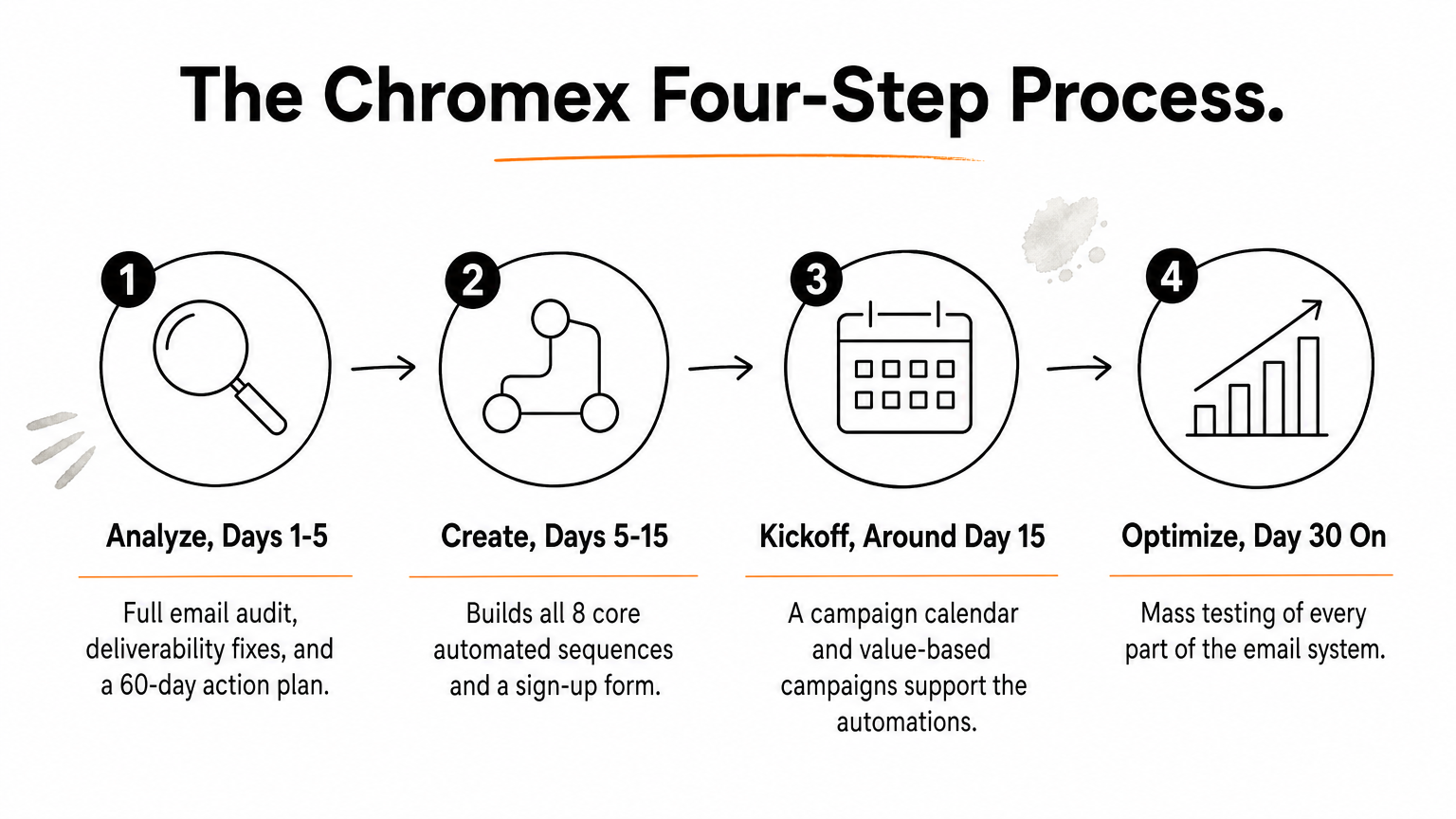
- Analyze (days 1 to 5): a full email audit, deliverability fixes, market and competitor insights, and a 60-day action plan.
- Create (days 5 to 15): all 8 core automated email sequences, plus a high-converting sign-up form for list growth.
- Kickoff (around day 15): a campaign calendar and value-based campaigns that support the automations.
- Optimize (day 30 onward): mass testing of every part of the email system, so gains compound month after month.
Other agencies use different names and timelines, but the order is sensible. Fix the foundation, build automations, add campaigns, then test.
Automations come before campaigns because flows earn revenue while you sleep.
What the agency needs from you
Your side of the work is small but important:
- Admin access to your email platform, such as Klaviyo or Omnisend, and your store
- Brand guidelines, logos, fonts and product photography
- Margins, best sellers and planned launches
- Past campaign data and customer feedback
- Quick approvals, since slow sign-off delays every send
What an email marketing agency costs
Common pricing models
Pricing varies with list size, send volume, whether SMS is included and how much design is custom. Retainers for ecommerce email commonly start in the low four figures per month and climb into five figures for large lists and heavy volume. Treat that as a general range, not a quote. Platform fees from Klaviyo or Omnisend are usually billed separately to you.
| Model | How it works | Watch for |
|---|---|---|
| Flat monthly retainer | Fixed fee for a defined scope | Paying the same whether results rise or not |
| Percentage of email revenue | Fee scales with attributed revenue | How "attributed" revenue is counted |
| Hybrid | Smaller base fee plus performance share | Clear caps and definitions |
| One-time project | Audit or flow build for a set price | Nobody owns results afterward |
Chromex prices on a transparent, performance-based model instead of fixed packages, so cost tracks what you get. For an exact figure, book a call.
A worked example: what the fee must beat
Say your store earns $100,000 a month and email brings in 8%, or $8,000. Moving email to 30% of revenue would mean $30,000, an extra $22,000 a month. At a 40% contribution margin, that is about $8,800 in added profit. A $4,000 monthly fee would leave roughly $4,800 after costs. The numbers are hypothetical.

Reaching that level takes months, and not all attributed revenue is truly incremental, since some customers would have bought anyway. Judge any agency on lift you can verify, not on a dashboard total.
The right question is not "what does it cost?" but "what extra profit does it have to produce?"
Is hiring an email marketing agency worth it?
When it pays off and when it does not
Hiring tends to pay off when you already have traffic, a list of meaningful size and email below roughly 10 to 20% of revenue. It also helps if you have been burned by an inconsistent freelancer, or if flows are weak or missing.
It rarely pays off when you have little traffic, a tiny list or an unproven product. In that case, set up the core flows yourself in Klaviyo or Omnisend and revisit an agency once the revenue is there to improve.
Downsides and questions to ask
The honest downsides are cost, a ramp-up period before results show and dependence on an outside team. Quality also varies widely, and big claims about "$30k a month" on agency sites are hard to verify.
Before you sign, ask these questions:
- Who writes, designs and manages my account day to day?
- How is revenue attributed, and how do you separate true lift?
- What is the contract length, and how do I exit?
- Can I see your reporting format and talk to current clients?
Vague answers on attribution and reporting are the clearest warning sign.
Where to go from here
An email marketing agency takes over the full system: audit, deliverability, flows, campaigns, design, testing and reporting. It earns its fee when it lifts profit, not vanity metrics. If your store has traffic and a list but email is a small slice of revenue, the math often works.
If you want to see how this looks for your store, see how Chromex runs email and SMS for ecommerce brands and book a call.