10 Best Shopify Email Marketing Agencies to Hire in 2026
Picking a Shopify email marketing agency is harder than it looks. Every agency claims Klaviyo expertise and big revenue lifts. Few show proof. If you have been burned by a freelancer who vanished or an agency that sent pretty emails with no sales behind them, you know the cost: wasted months and a stale list.
Here is the short answer. The best agencies for Shopify stores build revenue-focused flows and campaigns, report in plain language, and price based on results. Email should drive 30 to 40% of your monthly revenue, not 5%. If an agency cannot show case studies at that level, keep looking.
Below, you will find 10 agencies we compared on platform expertise, services, pricing model, and documented results. We run email and SMS programs for ecommerce brands at Chromex, so we know what good work looks like and what to ask before you sign. Use this list to build a shortlist and book calls with confidence.
How to choose a Shopify email marketing agency
Every agency here can send an email. What separates them is the work behind it and the proof they can show. Score each one on the three areas below before you book a call.
Platform and Shopify expertise
Platform fluency matters more than a logo wall. Ask which tool the team lives in, whether Klaviyo, Omnisend, or Shopify Email, and how they use your Shopify data connection: product feeds, customer tags, and checkout events. An agency that sends the same abandoned cart email to a $20 cart and a $400 cart is working from a template, and platform fluency is the first thing that exposes it. Listen for three things on the first call.
Core flows: welcome, abandoned cart, browse abandonment, post-purchase, and winback, built before any big campaign.
Deliverability: SPF, DKIM, and DMARC set up correctly, which Google requires from bulk senders.
Custom design: emails built around your brand, not a stock template.
Proof of results
Proof comes down to numbers you can check. Ask for email's share of total revenue before and after the engagement, not open rates. A healthy program drives 30 to 40% of monthly store revenue, while many stores sit under 10%. Case studies with named brands and dollar figures beat vague percentage claims.
Open rates are a vanity metric, and revenue per send is what pays you back.
Reference calls close the gap. Long client relationships of 1.5 years or more signal results that held up, and a retention rate above 90% tells you more than any testimonial page.
Pricing and reporting
Pricing should track the value you receive. Performance-based or percent-of-revenue models align incentives, and flat retainers work when the scope is clear. Be wary of any long lock-in before you have seen a written action plan.
Area | Good sign | Red flag |
|---|---|---|
Reporting | Plain language, revenue first | Dashboards of opens and clicks |
Contract | Month-to-month or short term | 12-month commitment upfront |
Speed | Replies within one business day | Account managers keep rotating |
Creative | Custom design in your brand voice | Reused templates |
1. Chromex
What they do
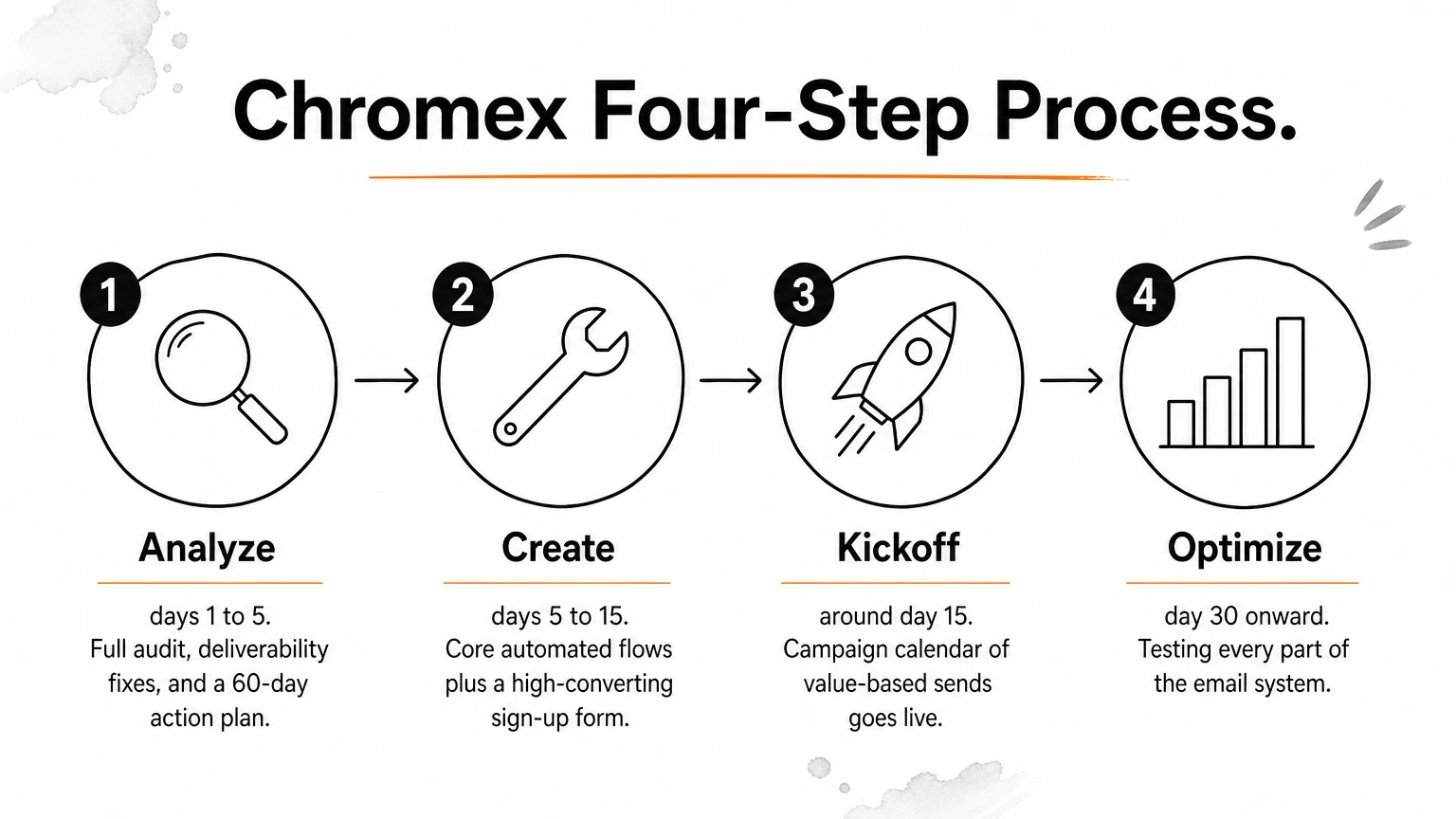
Chromex is a done-for-you email and SMS agency for ecommerce brands, and the one we know best because it is ours. The team covers strategy, flows, campaigns, custom design, testing, and reporting through a four-step process:
Analyze (days 1 to 5): full audit, deliverability fixes, competitor insights, and a 60-day action plan.
Create (days 5 to 15): the 8 core automated flows plus a high-converting sign-up form.
Kickoff (around day 15): a campaign calendar of value-based sends.
Optimize (day 30 onward): testing every part of the system.
Pricing and engagement model
Pricing is performance-based and scalable, not fixed packages, so you pay for what you get. There is no public rate card, so you book a call to get a quote.
The team works on major platforms, including Klaviyo, and is an official Omnisend partner. Sign-ups through its link get 20% off the first 2 months as cashback.
Results and proof
Chromex publishes its numbers, which is rare in this category. Email drives an average of 45% of clients' monthly revenue, and one case study generated $500,000+ with email at nearly 70% of monthly sales.
$14M+ in email-attributed revenue
92% client retention
335M+ emails and SMS sent
Email should earn its place as a revenue channel, not a line in a report.
Who it is best for
Stores already getting traffic and paid ad spend fit best, especially when email earns under 10% of revenue and you want 30 to 60%. It also suits brands burned by freelancers who want plain-language reporting and one steady team.
Limitations to consider
Chromex focuses on email and SMS. If you need paid ads, site development, or SEO from one vendor, you will need another partner.
Pricing also requires a conversation, so you cannot compare a number on a webpage. Brands that want to run everything in-house will find a done-for-you model more hands-off than they need.
2. Swanky Agency
What they do
Swanky is a full-service Shopify Plus agency, so email sits next to design and development instead of being the main product. That works well if you want one vendor for the whole store.
Email and lifecycle: flows and campaigns for Shopify stores.
Design and development: custom themes and store builds.
Conversion optimization: site tests that can feed your email strategy.
Pricing and engagement model
Swanky does not publish a rate card that we could find, so expect a scoped quote after a discovery call. Agencies of this type usually combine project fees with monthly retainers. Ask whether email is priced alone or bundled with other work, and whether you can start month-to-month before committing to a longer term.
Results and proof
Swanky shows client work and case studies on its site, mostly around store builds and redesigns. Before you put it on your shortlist for email, ask for email-specific numbers: email's share of total revenue before and after, tied to a named brand. Hold it to the same bar you would use for any Shopify email marketing agency.
A redesign result is not an email result, so ask to see the email numbers.
Who it is best for
Shopify Plus merchants planning a redesign or replatform fit best, especially if you want the same team handling site and inbox. It also suits brands that want email design tied closely to storefront changes, so your campaigns and landing pages look like one brand.
Limitations to consider
Email is one service among many here, so you may get less depth than a specialist that lives in flows, deliverability, and testing all day. Public pricing and email-specific proof are also thin, which makes comparing quotes harder. If email revenue is your main goal, press for a dedicated lifecycle lead and a written 60-to-90-day plan before you sign.
3. Lyfe Marketing
What they do
Lyfe Marketing is a full-service digital marketing agency that sells email alongside SEO, paid ads, social media, and web design. Email is one item on a broad menu, so treat it as a channel inside a bundle rather than a specialty. Typical email work includes:
Campaigns and newsletters
Automations and lifecycle flows
SEO, paid media, and social to feed your list
Pricing and engagement model
There is no public rate card that we could find, so expect a custom proposal after a consultation. Multi-channel agencies usually price by scope with a monthly retainer. Ask whether email can be quoted alone and whether the contract runs month-to-month before you commit.
Results and proof
Case studies and client reviews cover the agency's services in general, and most lean toward search and paid work rather than Shopify email. Request email-attributed revenue for a named store, plus email's share of total revenue before and after. Hold Lyfe to the same bar you would use for any Shopify email marketing agency.
Broad case studies prove an agency can market, not that its email makes money.
Who it is best for
Small to mid-sized stores that want one vendor for traffic and inbox fit best, especially if you lack the bandwidth to manage several partners. It also suits brands whose bigger gap is acquisition, where email is a supporting piece of a wider growth plan.
Limitations to consider
Because email is not the core product, you may get less flow depth than from a specialist that builds and tests automations daily. Thin public pricing and limited Shopify-specific proof also make quotes hard to compare. Ask who will actually build your flows, and whether that person works in Klaviyo every day or hands the work to a generalist account manager.
4. Barrel
What they do
Barrel is a Shopify Plus agency known for store design and development, with lifecycle email sitting inside a wider growth offer. The storefront comes first, and email supports it. Expect a mix like this:
Brand and UX design for your store
Shopify development, migrations, and replatforming
Email and lifecycle marketing tied to the new storefront
Pricing and engagement model
We could not find a public rate card, so plan on a scoped proposal after a discovery call. Agencies built around projects often combine project fees with monthly retainers. Ask whether email can be priced separately from a site build, and whether a month-to-month term is on the table.
Results and proof
Case studies on the site center on redesigns, builds, and brand work for ecommerce clients. That shows real Shopify depth, but it does not show what the inbox earned. Ask for email-attributed revenue from a named brand, plus email's share of total revenue before and after.
A great storefront case study does not prove a great abandoned cart flow.
Who it is best for
Established Shopify Plus brands planning a redesign fit best, especially when you want one team for site and inbox so campaigns, landing pages, and product pages look like one brand. It also suits stores with an in-house marketer who can own the day-to-day email calendar while the agency handles strategy and design.
Limitations to consider
Email is not Barrel's core product, so you may get less flow depth than a specialist that tests automations and deliverability every week. Project-style pricing can also feel heavy if all you need is a Shopify email marketing agency to fix flows and run campaigns. Ask who builds your automations, which platform they use daily, and how often you will see reporting.
5. Avex Designs
What they do
Avex Designs is a Shopify and Shopify Plus agency that pairs store design and development with Klaviyo-based email work. Like the two agencies before it, it leads with the storefront and treats email as a supporting service. Expect a mix like this:
Custom Shopify theme design and development
Migrations, app setup, and integrations
Klaviyo flows and campaigns tied to the new store
Pricing and engagement model
No public rate card turned up when we looked, so plan on a custom quote after a discovery call. Build work usually carries a one-time project fee, while ongoing email often runs as a monthly retainer. Ask whether email can be priced apart from development and whether a month-to-month term is available.
Results and proof
Case studies on the site center on store builds and design for Shopify brands. That shows real Shopify depth, but it does not show what the inbox earned. Ask for email-attributed revenue from a named store, plus email's share of total revenue before and after, the same bar you would set for any Shopify email marketing agency.
Storefront wins do not prove inbox wins, so ask for the email numbers.
Who it is best for
Merchants who need a store build or refresh and want one team to handle email afterward fit best. It also suits brands that want design and email to look like one system, with campaigns that match the new storefront from the first send.
Limitations to consider
Email is a secondary service here, so you may get less testing depth than a specialist that runs flows and deliverability work every week. Thin public pricing and limited email proof make quotes harder to compare. Ask who builds your automations and whether that person works in Klaviyo daily.
6. Cro Metrics
What they do
Cro Metrics is an experimentation and conversion rate optimization agency, so testing is the product and email is one place to apply it. The team runs structured A/B tests across sites, apps, and messaging. Expect a mix like this:
A hypothesis backlog and test roadmap
Site and checkout experiments
Lifecycle email tests tied to those findings
Pricing and engagement model
We could not find a public rate card, so plan on a custom proposal after a discovery call. Testing programs usually run as monthly retainers scaled to test volume. Ask whether email testing is included or priced as a separate line.
Results and proof
Case studies on the site focus on conversion lifts from experiments, mostly on websites and apps. That proves a disciplined testing method, but not what a Shopify store earned from its inbox. Ask for email-attributed revenue from a named brand, the same bar you would set for any Shopify email marketing agency.
A test win proves a method, so ask which wins happened in email.
Who it is best for
Higher-traffic stores fit best, because A/B tests need volume to reach reliable results. It also suits brands with an in-house email owner who can build flows while the agency supplies test strategy and analysis.
Limitations to consider
Email is not the core service, so you may get less hands-on flow building, list growth, and deliverability work than a specialist provides. Smaller stores may also lack the traffic to run tests quickly. If you want a team to build, design, and run your automations end to end, ask who owns day-to-day execution before you sign.
7. Uncap
What they do
Uncap is a lifecycle marketing agency that puts email and SMS at the center for ecommerce brands, which makes it closer to a specialist than the three agencies before it. Its work centers on Klaviyo and on retention revenue rather than store builds. Confirm the exact scope on a scoping call, but expect a mix like this:
Flow audits and builds for welcome, cart, browse, and post-purchase
Campaign planning, design, and execution
SMS alongside email
Ongoing testing and reporting
Pricing and engagement model
We could not find a public rate card, so plan on a custom quote after a discovery call. Retention specialists usually charge a monthly retainer, sometimes with a portion tied to revenue. Ask what the fee covers, whether SMS costs extra, and whether a month-to-month term is available.
Results and proof
Uncap shows client work on its site, but we could not independently verify the figures behind each result. Treat them as a starting point. Ask for email's share of total revenue before and after, plus email-attributed revenue from a named Shopify store. Hold Uncap to the same bar you would use for any Shopify email marketing agency.
A specialist should be able to show you the inbox numbers in the first call.
Who it is best for
Brands with steady traffic and a thin email program fit best, especially if you want a dedicated email and SMS team instead of a bundle of services. It also suits stores that already run Klaviyo and need sharper flows and testing rather than a new storefront.
Limitations to consider
Because the focus is narrow, you will need other partners for paid ads, SEO, or site development. Thin public pricing also makes quotes harder to compare. Ask who will build your automations, how often you will see reports, and whether the same strategist stays on your account.
8. Praella
What they do
Praella is a Shopify Plus agency that pairs store design, development, and conversion work with retention marketing. Email is one service inside a larger build-and-grow offer, so treat it as a supporting channel. Expect a mix like this:
Shopify Plus design, development, and replatforming
Conversion optimization for product and checkout pages
Klaviyo flows and campaigns for retention
Pricing and engagement model
We could not find a public rate card, so plan on a scoped proposal after a discovery call. Project work usually carries a one-time fee, and ongoing email tends to run as a monthly retainer. Ask whether email can be priced apart from development, and whether a month-to-month term is available.
Results and proof
Case studies on the site lean toward store builds and growth work for Shopify brands. That shows real Shopify depth, but it does not show what the inbox earned. Ask for email-attributed revenue from a named store, plus email's share of total revenue before and after. Hold Praella to the same bar you would use for any Shopify email marketing agency.
Store-level growth is not inbox growth, so ask to see the email numbers.
Who it is best for
Mid-market and Plus brands that need a store upgrade and want the same team to handle email afterward fit best. It also suits stores whose site and inbox must move together, such as a replatform that launches with a fresh welcome series.
Limitations to consider
Email is a secondary service here, so you may get less flow depth than a specialist that tests automations every week. Thin public pricing and limited email proof also make quotes harder to compare. Ask who builds your flows, how often you will see reports, and whether that person works in Klaviyo daily.
9. Command C
What they do
Command C is a Shopify agency that blends store design, development, and growth work, with email and retention as one service in the mix. Like several agencies above, it leads with the storefront. Confirm the exact scope on a first call, but expect something like this:
Shopify and Shopify Plus design and development
Conversion and UX improvements for product pages
Email flows and campaigns for retention
Pricing and engagement model
We could not find a public rate card, so plan on a scoped proposal after a discovery call. Build work usually carries a project fee, and ongoing email tends to run as a monthly retainer. Ask whether email can be priced apart from development, and whether a month-to-month term is available.
Results and proof
Case studies on the site center on store builds and brand work for ecommerce clients. That shows real Shopify depth, but it does not show what the inbox earned. Ask for email-attributed revenue from a named store, plus email's share of total revenue before and after. Hold Command C to the same bar you would use for any Shopify email marketing agency.
Design awards are nice, but only inbox revenue pays for email.
Who it is best for
Brands planning a store build or refresh fit best, especially if you want the same team to handle email once the new site launches. It also suits stores with an in-house marketer who can own the weekly campaign calendar while the agency handles design and strategy.
Limitations to consider
Email is a secondary service here, so you may get less flow depth than a specialist that tests automations every week. Thin public pricing and limited email proof also make quotes harder to compare. Ask who builds your flows, how often you will see reports, and whether that person works in Klaviyo daily.
10. Acidgreen
What they do
Acidgreen is a Shopify Plus agency that covers store design, development, and ongoing growth work, with email as one service inside the offer. Like most agencies on this list, it leads with the storefront. Confirm the exact scope on a first call, but expect a mix like this:
Shopify Plus design, development, and replatforming
Conversion and UX work on product and checkout pages
Email and retention marketing tied to the store
Pricing and engagement model
We could not find a public rate card, so plan on a scoped proposal after a discovery call. Build work usually carries a one-time project fee, and ongoing email tends to run as a monthly retainer.
Before you sign, ask whether email can be priced apart from development. Also ask whether a month-to-month term is available once the build is done.
Results and proof
Case studies on the site center on store builds and growth work for ecommerce brands. That shows real Shopify depth, but it does not show what the inbox earned. Ask for email-attributed revenue from a named store, plus email's share of total revenue before and after. Hold Acidgreen to the same bar you would use for any Shopify email marketing agency.
Store results are not inbox results, so ask to see the email numbers.
Who it is best for
Mid-market and Plus brands planning a store upgrade fit best, especially when you want the same team to handle email after launch. It also suits stores with an in-house marketer who can own the weekly campaign calendar while the agency handles design and strategy.
Limitations to consider
Email is a secondary service here, so you may get less flow depth than a specialist that tests automations every week. Thin public pricing and limited email proof also make quotes harder to compare. Ask who builds your flows, how often you will see reports, and whether that person works in Klaviyo daily.
Agency vs freelancer vs Shopify Email in-house
You have three real ways to run email on a Shopify store. You can hire a specialist agency, hire a freelancer, or handle everything yourself with Shopify Email. Each fits a different stage of growth.
How the three options compare
Start with what you get for the money. The table shows typical patterns, not fixed rules, so check it against any quote you receive.
Agency | Freelancer | Shopify Email in-house | |
|---|---|---|---|
Coverage | Strategy, design, flows, testing, reporting | Usually one or two skills | Basic campaigns and simple automations |
Reliability | A team covers vacations and turnover | Depends on one person | Depends on your free time |
Cost | Monthly retainer or performance-based | Hourly or flat project fee | Low software cost, high time cost |
Best for | Stores pushing email toward 30% of revenue | Small, defined projects | Stores just starting out |
Which one to pick
Shopify Email works while your list is small and you send a few campaigns a month. Outgrow it once you need segmentation by order value, browse abandonment, or deeper flow logic. Its automation options are lighter than Klaviyo or Omnisend.
Freelancers suit a one-off job, like building a welcome series. The risk is a single point of failure. If that person gets busy or disappears, your program stalls. For an ongoing program, a Shopify email marketing agency gives you a team, a process, and someone accountable for revenue.
Hire for the email program you need in a year, not the one you have today.
What Shopify email agencies cost
Cost is where comparing a Shopify email marketing agency gets messy, because most quotes are custom. The ranges below reflect what we see in the market, so treat them as rough benchmarks, not rate cards.

Common pricing models
Three structures show up again and again, and a one-time build is the fourth.
Model | How it works | Typical range |
|---|---|---|
Flat retainer | Fixed monthly fee for a set scope | $2,000 to $6,000 per month |
Percent of revenue | Fee tied to email-attributed sales | About 5 to 15% of email revenue |
Hybrid | Lower base fee plus a performance bonus | Base fee plus revenue share |
One-time project | Flow build or audit, no ongoing work | $3,000 to $10,000 |
Performance-based pricing suits stores that want the agency to share the risk. A flat retainer works when the scope is clear and you want predictable monthly costs.
What drives the price
List size, SMS volume, and flow count move a quote the most. A store with 200,000 subscribers and SMS needs far more work than one with 10,000 and a basic welcome series, and the fee should reflect that.
Bundles hide cost too. Full-service Shopify Plus agencies often fold email into a larger project fee, so you may pay for design and development you did not ask for.
The cheapest quote is rarely the cheapest program, because the real cost is the revenue you never earn.
How to compare quotes
Line up every quote on the same terms before you decide. Ask each agency to spell out:
What is included: flows, campaigns, design, SMS, and testing.
Platform fees: Klaviyo and Omnisend bills scale with your list and sit outside the agency fee.
Contract length: month-to-month beats a 12-month lock-in.
Reporting: revenue first, in plain language.
Questions to ask before you sign
Ten sales calls can sound identical. The questions below separate specialists from generalists and give you answers you can compare side by side. Ask them of every Shopify email marketing agency on your shortlist, and get the answers in writing so you can check them later.

Questions about results
Start with proof, because it is the hardest thing to fake. Ask for named case studies and a reference client you can call yourself.
What share of your clients' revenue comes from email, and how do you measure it?
Can I see email-attributed revenue for a Shopify store like mine?
Which engagement missed its goal, and what did you change?
Questions about the team
Who does the work matters as much as who sells it. Ask to meet the person who builds your flows, not just the account lead. Then confirm how fast they reply during a busy campaign week.
Who builds, designs, and reports, and will they stay on my account?
Which platform do you work in daily, Klaviyo or Omnisend?
How often will I see reports, and what will they show?
Never sign until you have met the person who will build your flows.
Questions about contract and exit
Finally, read the exit terms. Ask for the written 60-day action plan before any long commitment, and confirm that you own your accounts and data if you part ways.
Is month-to-month available, and what is the notice period?
Do I keep my flows, templates, and list when we end?
What does the fee exclude, such as SMS or platform bills?
Picking the right partner for your store
The right Shopify email marketing agency does one thing well: it turns your list into a revenue channel you can measure. Most agencies on this list lead with the storefront and treat email as a side service. That works if you need a rebuild. It does not work if your goal is moving email from 5% to 30% or more of monthly revenue.
So build your shortlist, ask the questions above, and demand email-attributed numbers from a named store. Get the 60-day plan in writing, and insist on month-to-month terms until results show up.
If you want a specialist team that builds your flows, designs every email, and reports in plain language, book a call with Chromex and see what your email program could earn.