Klaviyo Alternatives: 8 Options for Shopify Stores Compared
The best Klaviyo alternatives for most Shopify stores are Omnisend, Brevo and ActiveCampaign. Omnisend fits stores that want ecommerce email, SMS and web push at a lower price. Brevo suits big lists on a light sending schedule. ActiveCampaign suits teams whose automation goes beyond store events. Shopify Email and MailerLite cover small stores that want a free or cheap start.
Klaviyo is a strong platform, but it prices by active profiles, so your bill rises with your list whether those people buy or not. It also asks a lot of your time. This article compares eight options on pricing, free plans, Shopify integration and the places where each one breaks, so you can choose without opening ten more tabs.
Chromex Marketing runs email and SMS programs for ecommerce brands, mostly on Klaviyo and Omnisend. We are an official Omnisend partner, and we say so because it shapes the order of this list. We also tell you where Omnisend loses to Klaviyo. A platform is only part of your results, and we flag when the real problem is not the tool.
Why stores leave Klaviyo and how to compare the options
Stores leave Klaviyo for three reasons: cost that grows with the list, complexity that eats team time, and gaps in what it covers natively. Name your reason first, because the right pick among Klaviyo alternatives depends on it.
The real weaknesses of Klaviyo
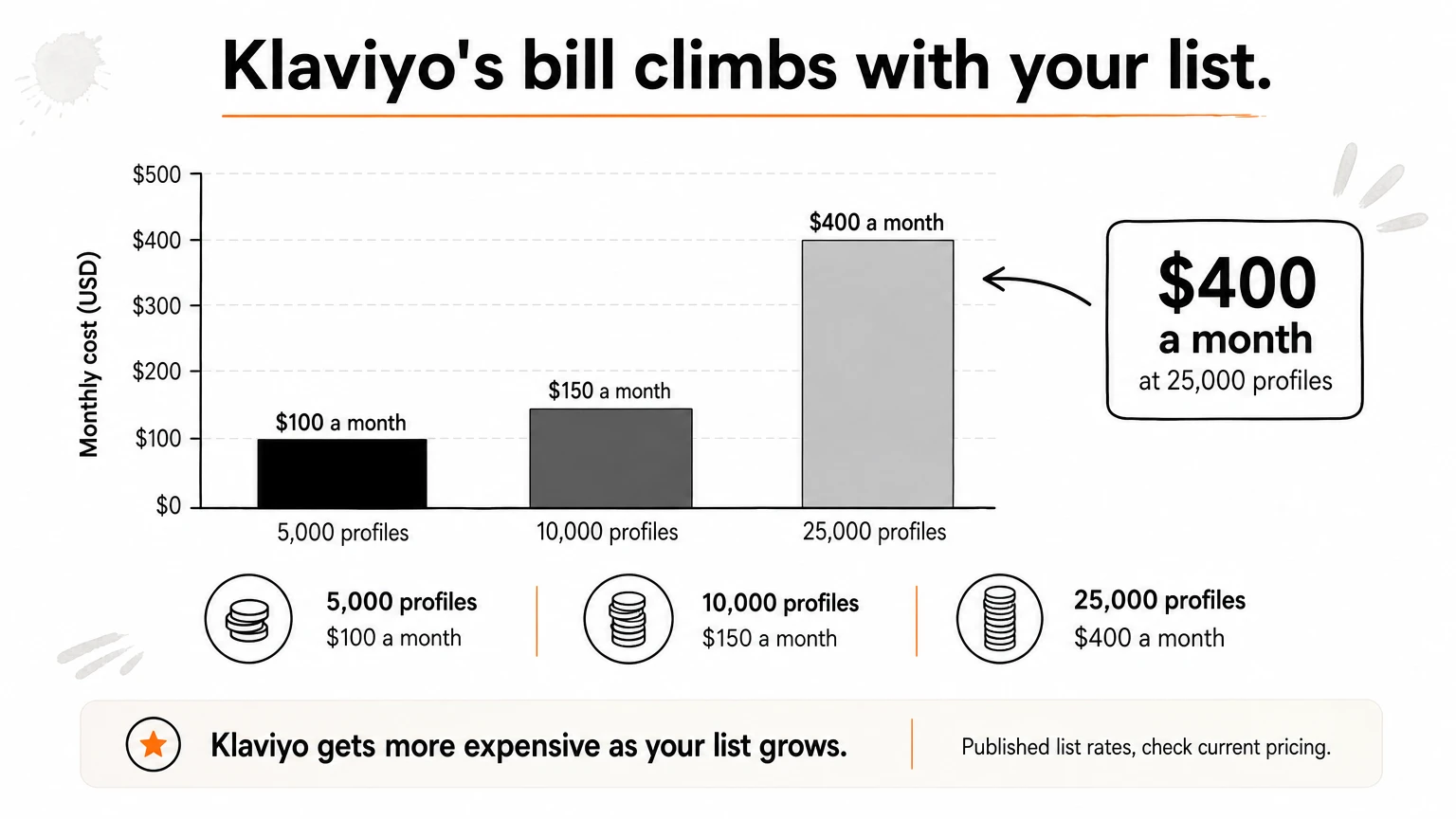
Pricing is the first complaint. Klaviyo charges by active profiles, so the bill follows your list, not your revenue. Published rates run about $100 a month at 5,000 profiles, around $150 at 10,000 and $400 at 25,000, and SMS costs extra. Check current rates before you decide, because plans change.
The second complaint is the learning curve. Flows, segments and data tools are deep, and new users often find them heavy. Support access also depends on your plan. The third is channel gaps: Klaviyo has no native web push, and its depth means more time spent managing flows than many small teams can spare.
Klaviyo is still the right call for some stores. Large teams on Shopify Plus that use its predictive analytics, and brands that rely on agencies who know it well, usually should stay. Everyone else may be paying for forecasting they glance at twice a year.
Switch because your bill or your workload no longer matches your results, not because a new tool looks shinier.
Klaviyo alternatives compared side by side
The table puts published list prices next to each other, with Klaviyo as the reference point. Use it to cut the field to two or three tools, then read those sections in full.
Platform | Best for | Starts at | Around 10K contacts | Free option | Shopify |
|---|---|---|---|---|---|
Klaviyo (reference) | Large ecommerce teams | $20/mo | About $150 | 250 contacts, 500 emails, 150 SMS | Native app |
Omnisend | Most Shopify and WooCommerce stores | $16/mo | About $132 | 250 contacts, 500 emails | Native app |
ActiveCampaign | Deep automation plus CRM | $15 to $19/mo | About $149 (Starter) | 14-day trial | Integration |
Brevo | Big lists, light sending | Free, Starter $25/mo | About $35 (volume based) | 300 emails a day, unlimited contacts | Integration |
Drip | Small stores wanting simplicity | $39/mo | About $154 | 14-day trial | Native app |
MailerLite | Lean, email-first stores | Free, paid by subscribers | Check its calculator | Yes, limited | Integration |
Mailchimp | Basic campaigns | $13/mo | About $110 | Limited free plan | Integration |
Shopify Email | Brand-new stores | Free | Free up to 10,000 sends a month | Yes | Built in |
Attentive | SMS-first brands | Custom quote | Custom quote | None, demo only | Integration |
Prices change often, and annual billing lowers some of them. The Brevo estimate assumes about four emails per contact each month, because it charges by volume, not list size.
What to check before you choose
Price is one filter, not the only one. A cheaper tool that cannot rebuild your best flow costs you more than the savings. Before you commit, test these points on a free plan or trial:
Shopify sync: products, orders, checkout events and customer tags should arrive without manual exports.
Channels: decide whether you need SMS, web push or both, and whether they are native or add-ons.
Contact counting: find out whether unsubscribed or inactive contacts count toward your bill.
Flow depth: rebuild your abandoned cart and welcome flows before you move anything else.
Free plan limits: check sends, contacts and which features stay locked.
1. Omnisend
Omnisend is the Klaviyo alternative we would test first for a standard Shopify or WooCommerce store. It covers the same core ecommerce jobs, adds web push, and costs less at most list sizes.
How it works
Omnisend was built for online stores from day one. Connect Shopify and it pulls in your product catalog, store styling, customer list and order history, so most stores send a first campaign the same day. Email, SMS and web push sit in one visual workflow. You can send an email, wait 24 hours, then text anyone who did not open it.
Reporting ties orders back to the campaign, automation step and A/B variant that produced them, which makes revenue attribution easy to read. Product picker blocks, AI product recommendations, prebuilt cart and welcome flows and gamified signup forms such as a wheel of fortune round out the toolkit.
Omnisend treats email, SMS and push as steps in one workflow, not three separate tools.
Pricing and free plan
Omnisend publishes simple tiers, and the free plan includes the full feature set within its sending limits. At the same list size it usually costs less than Klaviyo. The main tiers look like this:
Free: 250 contacts and 500 emails a month
Standard: from $16 a month for 500 contacts, about $132 at 10,000 contacts
Pro: from $59 a month, with advanced features and SMS credits equal to your plan cost
Chromex is an official Omnisend partner, and sign-ups through our link get an Omnisend discount of 20% off the first two months, paid as cashback. The free plan is enough to test your own flows before you move anything.
Who it suits
Choose Omnisend if you run a standard ecommerce store, send email plus SMS, and the Klaviyo invoice has started to sting. It also fits teams that want less setup time, since most users find it easier to learn than Klaviyo.
Know the trade-offs. Its templates are less polished than Klaviyo's, it has no predictive forecasting or peer benchmarks, the integration library is smaller, and the landing page builder is basic. Standard plans also cap monthly sends at 12 times your list size, which matters if you email daily. If you do not sell products, skip it.
2. ActiveCampaign
ActiveCampaign is the pick among Klaviyo alternatives when your marketing runs past store transactions. It has one of the deepest automation builders on this list, and it comes with a CRM.
How it works
The builder handles conditional branches, split tests across whole paths and goal exits. Triggers can come from purchases, site visits, engagement and CRM data. A store that also sells courses, services or B2B deals can run all of it in one system, across email, SMS and WhatsApp.
Its AI can suggest segments, draft campaigns and critique existing sequences. Treat it as an assistant, not an autopilot. It can miss layout instructions or rebuild an email when you only asked for a small change, so someone should check every variant before it goes live.
ActiveCampaign wins on automation depth, but you pay for that depth in setup time.
Pricing and free plan
There is no permanent free plan, only a 14-day trial. Entry pricing looks low, but the features most people switch for sit higher up, so budget for the Plus or Pro tier if automation and AI are your reasons.
Starter: about $15 to $19 a month for 1,000 contacts, depending on billing term
Starter at 10,000 contacts: about $149 a month
Plus: from about $59 a month for more automation and ecommerce features
Check how the platform bills unsubscribed and bounced contacts on new accounts, and clean your list before importing it.
Who it suits
Choose ActiveCampaign if you need workflow automation beyond cart reminders, such as lead nurturing, onboarding sequences or sales follow-up tied to a CRM. Teams with a dedicated marketer get the most from it.
It is harder to justify for a simple newsletter plus an abandoned cart flow. You will configure options a plain store never uses. The CRM and reporting are average, support can be hard to reach, and the learning curve is steeper than Omnisend's. For a straightforward shop, Omnisend is easier to defend on cost.
3. Brevo
Brevo, formerly Sendinblue, is the cheapest of the best Klaviyo alternatives when your list is large and your sending is moderate. It charges by email volume, not by contact count.
How it works
Every plan, including the free one, allows unlimited contacts. You pay for what you send, so a big list on a monthly newsletter costs very little. Klaviyo charges by headcount whether you email people or not.
Brevo bundles email, SMS, WhatsApp and transactional email, which helps if your store sends order confirmations and password resets from the same account. It covers standard ecommerce flows such as welcome and abandoned cart. Its Shopify connection syncs the basics you need to start.
Brevo flips the pricing model, so the less you send per contact, the more you save.
Pricing and free plan
On Brevo or Klaviyo, the winner depends on your sending pattern. If you email each contact four times a month, Brevo lands near $35 at 10,000 contacts. If you send daily, volume-based costs climb and the gap shrinks.
Free: 300 emails a day with unlimited contacts
Starter: about $25 a month for 20,000 emails
SMS: credits cost extra, unlike plans that bundle them
Treat these as starting points and run your own monthly send count through the pricing page.
Who it suits
Choose Brevo if the invoice decides everything, your list is big, and you send a few campaigns plus core flows. Stores that need transactional email in the same account get extra value.
The ceiling is automation. There are no split-testing paths, no predictive sending, and nothing close to Omnisend's ecommerce depth, such as catalog-driven product pickers. Store owners also report throttling when send volume spikes, which is worth testing before a big sale weekend.
4. Drip
Drip is an ecommerce-focused option for small stores that want a single plan and a quick setup. It is not the cheapest of the Klaviyo alternatives, but it is easy to reason about.
How it works
Drip builds campaigns around store behavior. Triggers include browsing, product views, purchases and cart activity, and the segmentation is behavior based. It connects natively to Shopify and also supports other store platforms, with 90+ integrations in total.
The customer timeline is the standout feature. One screen shows a shopper's emails, purchases, site activity and engagement history, so you can see what led to a sale. Revenue attribution and sales reporting sit alongside it.
Drip's customer timeline shows you the path to purchase, which helps when you are tuning flows by hand.
Pricing and free plan
Drip has no free plan, only a 14-day trial. It uses a single pricing model, and every feature is included at every tier, so there is no upgrade hunt. Pricing scales with active people on your list.
Entry: $39 a month for up to 2,500 contacts, with unlimited emails
At 10,000 contacts: about $154 a month
That 10,000-contact figure is above Omnisend and close to Klaviyo's, so Drip rarely wins on cost.
Who it suits
Choose Drip if you are a small store with basic needs, you want to be live in an afternoon, and you value clean design and a simple structure over long-term headroom. If you outgrow it, you will leave before you have built much that is painful to migrate.
The limits show up fast. Shopify users get only a short list of prebuilt automations, the action list is small, and a larger list gets expensive for the automation you receive. Stores that need SMS-heavy or push-heavy programs should look elsewhere.
5. MailerLite
MailerLite is the lean, email-first choice among Klaviyo alternatives, and it is a regular recommendation when store owners want something cheaper and simpler.
How it works
MailerLite offers a drag-and-drop editor, an automation builder with ecommerce triggers such as abandoned cart, signup forms, landing pages and a Shopify integration for syncing products and customers. The interface is clean, and a new user can launch a welcome flow quickly.
In Reddit threads where store owners ask for a cheaper Klaviyo, MailerLite and Omnisend come up again and again. The common verdict is that it is lighter on features but enough for core ecommerce flows. Reddit advice skews toward whatever was cheapest at the poster's list size, so test with your own flows before you trust it.
MailerLite gives you the core ecommerce flows at a lower price, in exchange for less depth.
Pricing and free plan
MailerLite offers a free plan with limits, and its paid tiers scale with your subscriber count. Because exact tiers and limits change, use its pricing calculator with your real list size.
Free: limited subscribers and sends, with core automation included
Paid: priced by subscriber count, with higher tiers adding features
Compare cost against Omnisend and Brevo at your list size
Who it suits
Choose MailerLite if you are an email-first store, your flows are standard, and you want the lowest learning curve in this group. It works well for stores that treat email as one channel among several, not the main revenue driver.
It is not built for deep ecommerce analytics. Expect less revenue attribution and weaker predictive features than Klaviyo. It has historically been email-first, so if SMS is central to your plan, confirm how it handles texting before you commit.
6. Mailchimp
Mailchimp is the name every store owner knows, and it is a cheap fallback among alternatives to Klaviyo if your needs are basic. It is rarely the best fit for a store built on automation.
How it works
Mailchimp guides new users through campaign creation, with plenty of prebuilt templates and AI tools that draft copy and build on-brand layouts from your site. The Customer Journey Builder handles multi-step automations, and prebuilt flows cover welcome, abandoned cart and nurture.
It is also where the compromises appear. SMS is an add-on, there is no web push, automation is shallower than in Klaviyo or ActiveCampaign, and revenue attribution is basic. Many stores leave Mailchimp as they grow, and few move to it from Klaviyo.
Moving from Klaviyo to Mailchimp swaps analytics depth for a slightly smaller invoice.
Pricing and free plan
Mailchimp has a limited free plan, and its paid tiers climb quickly. Advanced automation and generative AI sit above the entry tier.
Free: limited contacts and sends
Essentials: from $13 a month, with limited automation
Standard: from $20 a month, adding advanced automation and generative AI
Premium: from $350 a month for larger teams
At 10,000 contacts, expect roughly $110 a month on published rates.
Who it suits
Choose Mailchimp if you send basic campaigns, automation barely features in your plans, and brand familiarity matters to you. It works for stores that need a newsletter and one or two simple flows.
Skip it if flows drive your revenue. It can also bill you for unsubscribed contacts, which erodes the price advantage. If automation is central to the store, Omnisend gives you more for similar money.
7. Shopify Email
Shopify Email is the right answer among Klaviyo alternatives for Shopify stores that are brand new and still building a first list. You may not need a replacement yet, just a free placeholder.
How it works
Shopify Email lives inside your Shopify admin, so there is no integration work. Store data is already there, and sales are attributed to the right emails automatically. You can design and send a campaign from the same place you manage orders.
The Shopify Email automation side is thin. You get about six prebuilt templates, no A/B testing, mediocre template designs and an editor that sometimes needs a page refresh. That is enough for a welcome email, an abandoned cart reminder and a few promotions.
Shopify Email is the best starting point for a store with no list yet, and the worst place to stay once flows matter.
Pricing and free plan
Shopify Email is free for up to 10,000 sends a month. Past that, you pay per send. There is no separate platform fee.
Free sends: up to 10,000 a month
Extra sends: charged per email
SMS and push: not included in the same way as dedicated platforms
For a store with a small list, that makes it the cheapest option here.
Who it suits
Choose Shopify Email if you are pre-revenue or close to it and want a clean start with zero setup. It lets you collect and email your first subscribers without another monthly bill.
Graduate to Omnisend's free plan once you want more than the basics, such as multi-channel flows, A/B tests and richer reporting. Do not stay on Shopify Email if email is meant to produce 30% or more of your revenue, because the tool will cap the program.
8. Attentive
Attentive is the SMS-first entry among Klaviyo alternatives. It suits stores where texting is a major revenue channel, not a side channel.
How it works
Almost every feature is built to grow and monetize a text program. Attentive offers popups, signup forms and targeting tools for collecting SMS subscribers, then sends flows and campaigns personalized by browsing activity, purchase history, product interests and location.
Email is supported, and you can build email and SMS journeys in a single workflow with A/B testing across both. The email builder is straightforward, but email is the secondary channel here, and the tool's depth sits on the SMS side.
Attentive is for stores that already know texting works and want to scale it.
Pricing and free plan
Attentive does not publish prices. It uses custom quotes based on business size and messaging volume, and there is no free plan. You book a demo and get a number.
Pricing: custom, based on volume and business size
Free plan: none
Testing: demo and sales conversation first
Budget for this as a larger commitment than the other tools here.
Who it suits
Choose Attentive if SMS already drives a meaningful share of your revenue, you run launches, flash sales and back-in-stock alerts by text, and you have the volume to justify custom pricing.
Skip it if you are email-first or watching every dollar. The lack of public pricing makes comparison harder, and email-first stores will use only part of it. Wherever you send texts, keep documented consent for every subscriber.
How to choose and switch without losing revenue
Choose by your biggest constraint, then move your flows in order of revenue, not all at once. A careful migration protects the revenue Klaviyo currently earns for you.
Match the tool to your situation
If you want a shortlist of three, start with Omnisend, Brevo and ActiveCampaign. They cover the most common reasons stores leave. The best Klaviyo alternatives are the ones that match your constraint:
Standard Shopify store, bills rising: Omnisend
Large list, light sending: Brevo
Automation beyond store events: ActiveCampaign
Cheap, email-first, simple flows: MailerLite
Pre-revenue store: Shopify Email, then Omnisend's free plan
Texting drives revenue: Attentive
Move in the right order
Do not cancel Klaviyo on day one. Follow this sequence so no revenue flow goes dark:

Export your lists with consent status, unsubscribes and suppressions. Carry over SMS consent records too.
Authenticate your sending domain with SPF, DKIM and DMARC on the new platform.
Rebuild flows by revenue, starting with abandoned cart, then welcome, post-purchase, browse abandonment and winback.
Warm up gradually. Send to your most engaged subscribers first and raise volume over a few weeks.
Run both platforms briefly, then pause the old flows one by one.
Keep your Klaviyo account read-only for a month, because people realize they need old campaign data weeks after cancelling.
The risky part of switching is not the new tool, it is the weeks when deliverability and flows are half built.
Some platforms help with the move. Omnisend offers a self-serve migration tool and team-assisted migration on paid plans, and ActiveCampaign offers migration help on qualifying plans. Ask exactly what each team rebuilds. If nobody on your team has the time, an ecommerce email agency can run it. Chromex starts with an email audit and deliverability fixes, then builds the eight core flows and a signup form within the first 15 days.
Other names you will see
Flodesk comes up when people ask whether it beats Klaviyo. It is built around design-first email, so check its ecommerce automation against your flows before you move. Constant Contact suits small businesses that want email, SMS and social in one place, but it is not an ecommerce specialist.
Moosend is cheap and has strong automation for the price, but it has no native Shopify integration, so Shopify stores need a workaround. None of these three beat the eight above for a typical Shopify store, though each can fit a narrower case.
Which one to try first
Klaviyo is not the problem for every store, but its bill and its complexity are real. Match your reason for leaving to the tool: Omnisend for most Shopify stores, Brevo for big lists and light sending, ActiveCampaign for deep automation, and Shopify Email for a brand-new list.
Test on a free plan or trial with your own abandoned cart and welcome flows before you migrate anything that earns money.
If you would rather have specialists handle the move and run the program afterward, compare Shopify email marketing agencies or book a call with Chromex. We will look at your flows, deliverability and list before you change a thing.